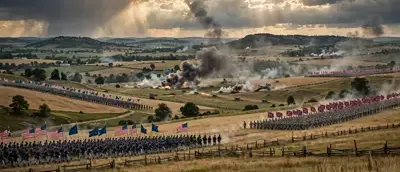
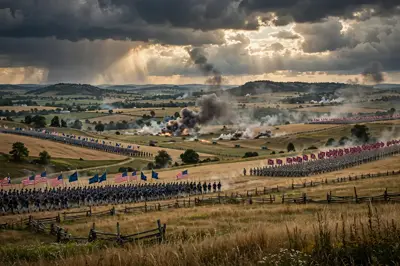
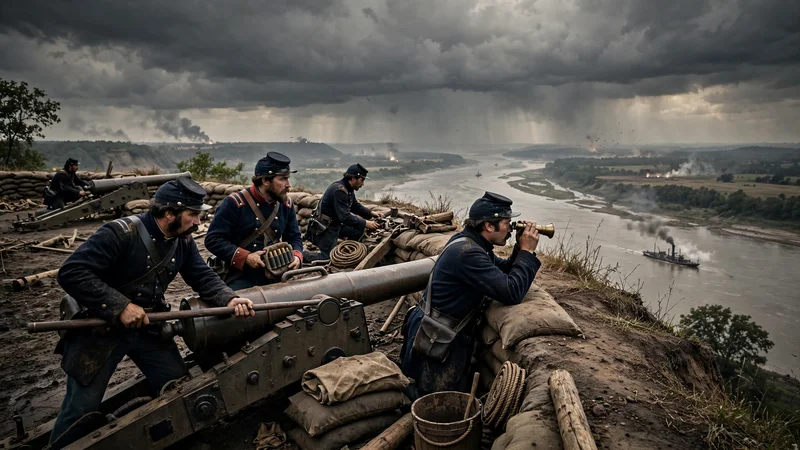
Picture a stone wall four feet high and four hundred yards long, packed three deep with riflemen. Above it, on the crest of a low hill, more cannon than most men had ever seen in one place. Now picture yourself ordered to cross half a mile of open, rising ground to take that wall. On December 13, 1862, the Union army got that order fourteen times. The wall held. Most of the men who charged it didn't come back.
Why Would Anyone Charge a Stone Wall?
Historians have chewed on that question for 160 years. It's the right place to start. The answer isn't courage or stupidity, though the field held plenty of both. Burnside had run out of options, and he knew it. By the time his army stood below Marye's Heights, every good choice was already gone.
The Battle of Fredericksburg was a five-day Civil War clash, December 11 to 15, 1862, at Fredericksburg, Virginia. Union general Ambrose Burnside attacked Robert E. Lee's entrenched army with about 114,000 men against roughly 75,000. The main fighting came December 13, when Union assaults broke against the stone wall at Marye's Heights. The Confederates won decisively.
See the trap? Burnside's whole campaign was built on speed. Cross the river fast, march on Richmond fast, end the war before Lee could dig in. The plan needed pontoon bridges in mid-November. They arrived late. And Lee, who never wasted a gift, spent the delay turning a low hill into a fortress.
So on the morning of the 13th, Burnside looked at a nearly perfect defensive position and ordered his men to walk into it. You've probably wondered what kind of general does that. Keep reading. The answer is more human, and sadder, than you'd think.
Burnside Didn't Even Want the Job
To understand Fredericksburg you have to start a month earlier, on November 7, 1862, when Abraham Lincoln finally fired George McClellan. McClellan had fought Lee to a standstill at Antietam in September and then, characteristically, refused to chase him. Lincoln was done waiting. He offered the Army of the Potomac to Ambrose Burnside, who said no. He offered it again. Burnside said no again. Only when Lincoln made it an order did Burnside take the job. Remember that detail. It matters.
Burnside was a decent corps commander and, by most accounts, a genuinely likable man. His soldiers liked him. His fellow generals respected him. He also knew, better than anyone, that he wasn't the man for the job. That's not me being cruel. He said as much himself. And yet he took it, because Lincoln needed a fighter and the Northern newspapers needed a headline, and the whole country was screaming "On to Richmond" after the fall midterms gave the Democrats new ammunition.
Burnside's plan was actually good. His idea was to move fast, cross the Rappahannock at Fredericksburg before Lee could react, and drive the 50-odd miles to Richmond before the Confederates concentrated. Speed was the entire plan. Which is exactly why the next two weeks broke it.
The Two Weeks That Killed the Plan
Burnside's army reached Falmouth, across the river from Fredericksburg, on November 17. His pontoon bridges, the floating bridges his whole crossing depended on, were supposed to be waiting. They weren't. Somewhere between Washington and Virginia, in the kind of bureaucratic tangle that loses wars, the pontoons had been delayed. They didn't arrive until late November, more than a week late.
A week. That's all it took.
In this war, a week was everything. Lee had been watching Burnside's movement with growing suspicion, and the delay told him exactly where the blow would fall. By early December the Army of Northern Virginia, some 72,500 to 78,000 men, was dug in along a seven-mile line south of the Rappahannock. James Longstreet's corps held the left, on Marye's Heights. Stonewall Jackson's held the right, at Prospect Hill.
Burnside fumed and blamed Washington. Washington, meaning General-in-Chief Henry Halleck, blamed Burnside for changing the plan midstream. Both had a point. Neither had a solution. The pontoon fiasco turned a race into a siege, and Burnside, the man who hadn't wanted the job, now had to attack the strongest position Lee had ever held. Or admit the campaign was over before it began. He chose to attack.
The numbers tell you how lopsided the setup was. Burnside: roughly 114,000 to 120,000 men. Lee: roughly 72,500 to 78,000. On paper, a crushing Union advantage. But Lee's men stood behind a stone wall, on a hill, with artillery sighted on every approach. In 1862, against prepared defenses, numbers like that didn't buy what you'd expect. Fredericksburg would prove it in the bloodiest possible way.
December 11: Crossing Under Fire
Burnside finally crossed on December 11, and even that was a fight. His engineers tried to lay the pontoon bridges in the morning fog, and Confederate sharpshooters, about 1,600 Mississippians under Brig. Gen. William Barksdale, picked them off from houses along the riverbank. The engineers kept working. Men kept falling. The bridges weren't getting built.
So the Union did something desperate and brilliant. Artillery from Stafford Heights on the Union side opened up on the town, one of the heaviest bombardments of the war, and under that cover, the 7th Michigan and the 19th and 20th Massachusetts crossed the Rappahannock in the pontoon boats themselves, stormed the far bank, and drove Barksdale's men out house by house. The first amphibious assault of the American Civil War, if you want the trivia. It worked.
What happened next was uglier. With the town taken, Union soldiers sacked Fredericksburg. They looted homes, smashed furniture, stole everything they could carry. This wasn't Burnside's order. It just happened, the way it happens when you hand angry young men a town and no supervision. It's the part of the story the recruiting posters left out.
By the night of December 11 the bridges were down. On the 12th, Burnside's army poured across the river and deployed in the plain below the heights. Lee watched it happen and didn't interfere.
He didn't need to. The trap was set, and the Union army was walking into it.
Meade's Almost-Breakthrough at Prospect Hill
Burnside's plan for December 13 was a two-pronged attack. William Franklin's Left Grand Division would hit Jackson at Prospect Hill, south of town. Edwin Sumner's Right Grand Division would take Marye's Heights. On paper, Franklin had the numbers and Jackson had the reputation. What happened surprised almost everyone.
Around mid-morning, George Meade's Pennsylvania division found a gap in Jackson's line, a marshy stretch along an unfinished railroad grade, the so-called military road, where the Confederate defenses were thin. Meade's men pushed through it and broke Jackson's line clean open. For about an hour, the Union had a real, genuine breakthrough. Confederate brigades were falling back. The battle hung in the balance. And then it fell apart, because nobody came to help Meade. Jubal Early's Confederate division counterattacked, Meade's unsupported men were driven back with heavy losses, and Brig. Gen. Conrad F. Gregg was killed trying to hold the line.
Who's to blame for the missing support? That's still argued. Franklin later said Burnside's orders were vague and contradictory, and that he was told to hold his men ready rather than commit them. Burnside said Franklin had his orders and sat on them. Here's what nobody disputes: Meade's breakthrough died alone, and with it died the only real chance the Union had that day. Everything after that was the wall.
December 13: The Wall
While Meade was fighting at Prospect Hill, the main event was unfolding a mile to the north. Around noon, Burnside ordered Sumner's men forward against Marye's Heights. The first division to go was William French's. They crossed the canal ditch, formed up in the open, and marched toward the stone wall. Confederate infantry behind the wall, three ranks deep in places, waited until the range was point-blank. Then they fired.
The wall was held by Georgians and North Carolinians, with Brig. Gen. Thomas R. R. Cobb's Georgia brigade at its center. Behind them, up the slope, Longstreet had stacked artillery under Lt. Col. Edward Porter Alexander, who had supposedly remarked that "a chicken could not live on that field when we open on it." French's men melted. Then came Winfield Scott Hancock's division. Then more. Brigade after brigade, fourteen in all by most counts, crossed that open ground and broke against the wall like waves against a cliff.
He was right.
It went on all afternoon. Officers led from the front and died from the front. Cobb himself was mortally wounded at the wall. Union color-bearers kept picking up fallen flags and walking forward. At dusk, Brig. Gen. Andrew Humphreys personally led his division in a final charge, on horseback, straight at the guns, and somehow survived. Nothing moved the Confederates. When darkness fell, the field below Marye's Heights was covered with Union dead and wounded, men who had gotten within a few dozen yards of a wall they could never take. Lee, watching from the heights, turned to Longstreet and said what may be his most famous line: "It is well that war is so terrible, lest we should grow too fond of it."
The next day, December 14, there was a strange quiet. And in that quiet came the battle's one famous act of mercy. A Confederate sergeant named Richard Kirkland asked his officers for permission to carry water to the wounded Union soldiers lying between the lines. They gave it. Both sides held their fire while he worked. The Southern papers later called him the Angel of Marye's Heights. It's a small story. But when the big story is this grim, the small ones are the ones you hold onto.
Burnside, incredibly, wanted to attack again. He talked about leading the assault himself on the 15th. His generals, Sumner chief among them, talked him out of it. On the night of December 15, under cover of darkness and a storm, the Army of the Potomac slipped back across the Rappahannock. By morning the bridges were gone and the heights were empty of blue uniforms. The battle was over. The Confederates had won, and it wasn't close.
Could Burnside Have Won? An Honest Look
Honestly? Probably not, at least not on December 13. Lee's position was too strong, his artillery too well placed, and the Union's advantage in numbers couldn't buy its way past that wall. But here's the uncomfortable truth nobody likes to say about Fredericksburg: Burnside could have lost a lot less. He kept ordering assaults long after every one of them had failed in exactly the same way.
That's the honest downside of this story, and it belongs to Burnside. His own corps commanders could see the slaughter, Sumner watching his men die by the regiment, and Burnside's answer that afternoon was to keep sending them in. A general's hardest job isn't ordering the attack. It's calling it off. Burnside couldn't do it.
But hold on. Before you write him off as an idiot, remember two things. First, the pontoon delay that doomed the campaign wasn't his fault. Second, he was the only general in the Army of the Potomac who told the truth about himself: he didn't want the command, and he knew his limits. Most failed generals blame everyone else. Burnside blamed himself. After the war he said Fredericksburg was his fault, and he meant it.
That's not nothing.
What the Sources Say About the Numbers
A quick note on the figures, because Civil War numbers always come with asterisks. The strength figures used here, about 114,000 to 120,000 Union and about 72,500 to 78,000 Confederate, are the standard ranges you'll find in the National Park Service's Fredericksburg and Spotsylvania battlefield materials and the American Battlefield Trust's battle summary. They vary because "present for duty" and "engaged" are different things, and because 1860s paperwork was 1860s paperwork.
Casualty figures: the Union lost about 12,653 men (1,284 killed, 9,600 wounded, 1,769 missing or captured). The Confederates lost about 5,377 (608 killed, 4,116 wounded, 653 missing or captured). Those come from the Official Records, the two armies' after-action reports, and they're the numbers the Park Service uses. Notice the ratio. The Union outnumbered the Confederates and still lost more than twice as many men. That's the whole battle in one statistic.
3 Lessons from Fredericksburg
Fredericksburg is a battle, but it's also a warning. Three lessons worth keeping:
1. Logistics eat strategy for breakfast. Burnside's plan was fine. His pontoons were late. Wars are won by the boring stuff, bridges, wagons, timetables, and lost by the same. If you run anything complicated, remember Fredericksburg: the brilliant plan means nothing if the delivery truck doesn't show up.
2. Courage doesn't beat earthworks. The Union soldiers at Marye's Heights were as brave as any men who ever fought. It didn't matter. Frontal assaults against prepared positions were already obsolete in 1862, and every general who kept ordering them was spending lives to learn what the ground already knew. Pick a different angle. Always pick a different angle.
3. Stop digging when you're in a hole. Burnside's tragedy wasn't the first failed assault. It was the thirteenth. Leaders everywhere do this, doubling down on a failed approach because admitting it failed feels worse than the losses. It never is.
After Fredericksburg: Mud, Chancellorsville, and the Field Today
Burnside did not get a second chance to attack. On January 20, 1863, he tried to redeem the campaign with a winter offensive upriver, a plan to cross the Rappahannock above Fredericksburg and outflank Lee. That night the rain came, and for two days it turned the roads into rivers of mud. Wagons, guns, and men bogged down where they stood, and Burnside called the movement off on January 22. The army called it the Mud March, and it was Burnside's last campaign. On January 25, 1863, Lincoln replaced him with Joseph Hooker.
Hooker spent the spring rebuilding the army, then struck at Chancellorsville in late April 1863. This time the tables turned on Marye's Heights. On May 3, 1863, during the Chancellorsville campaign, Sedgwick's Union VI Corps assaulted and carried the Confederate entrenchments on the heights. The same wall that had swallowed fourteen Union assaults in December fell in a single morning, according to the National Park Service's battle summary. But the campaign was already lost elsewhere: Hooker's main army had been beaten at Chancellorsville, Sedgwick was stopped four miles west at Salem Church, and Lee pushed him back across the Rappahannock at Banks Ford. The wall that had cost Burnside his command fell in hours to a commander with enough men in the right place, and it changed nothing. The decision was being made at Chancellorsville, and Lee won it.
There is a pattern here worth naming. At Agincourt in 1415, French knights charged into a storm of English arrows across a muddy field and were destroyed. At Fredericksburg, Burnside's men charged into canister and rifle fire across open ground and were destroyed. Different centuries, different weapons, the same error: massed courage spent against a prepared position. Frontal assaults against prepared defenses were already obsolete in 1862, and Fredericksburg is the bloodiest proof of it.
The ground is still there to walk. The Fredericksburg and Spotsylvania National Military Park was established in February 1927 under the War Department and transferred to the National Park Service in 1933. It now covers more than 8,300 acres across four battlefields: Fredericksburg, Chancellorsville, the Wilderness, and Spotsylvania Court House. Fittingly, the modern American battlefield preservation movement began in this same town. In July 1987, historians and Civil War buffs gathered in Fredericksburg to create the first organization dedicated to saving battlefield land by buying it. The American Battlefield Trust's campaign to preserve the Slaughter Pen Farm, the 208-acre tract south of town where some of the December 13, 1862 fighting raged, ranks among the costliest private battlefield preservation efforts in American history.
Fredericksburg ended a campaign, ended a general's command, and announced that courage could not buy what position had already sold. Judge it against the standard of history's most decisive battles: it did not turn the war, but it broke an army's faith in its leadership, and that break mattered.
Sources
- National Park Service, Fredericksburg & Spotsylvania National Military Park
- American Battlefield Trust, Battle of Fredericksburg
- Wikipedia, Battle of Fredericksburg
- The War of the Rebellion: A Compilation of the Official Records of the Union and Confederate Armies, Series I, Vol. XXI
- National Park Service, Fredericksburg II battle detail (Sedgwick's VI Corps takes Marye's Heights, May 3, 1863)
- Gilder Lehrman Institute, Brooks D. Simpson, Scholar's Blog: January 20, 1863, "Mud March" of the Army of the Potomac (the January 20 to 22, 1863 movement and Burnside's replacement by Hooker)
- Essential Civil War Curriculum, Battlefield Preservation (the park's 1927 establishment and the July 1987 founding of the preservation movement in Fredericksburg)