July 18, 1863, was a bad evening to be a Union soldier on Morris Island, South Carolina. The sun was going down, the tide was coming in, and about 600 Black men from Massachusetts were about to run straight at a fort that had already beaten one Union attack a week earlier. They knew what waited for them. They went anyway. And by the time the shooting stopped, the whole country knew the name of their regiment. This is the story of the 54th Massachusetts and the sand fort that made them famous.
The Battle of Fort Wagner was the failed Union assault of July 18, 1863, on a Confederate sand fort guarding Charleston Harbor, South Carolina. Led by the 54th Massachusetts, one of the first Black regiments in the Union Army, about 5,000 Federal troops attacked at dusk and lost 1,515 men. The defeat proved Black soldiers' courage and changed the war.
Why Charleston? The Harbor the Union Had to Close
Start with the harbor. Charleston was the city where the Civil War began. On April 12, 1861, Confederate guns opened fire on Fort Sumter, right there in the same harbor, and the war started. Two years later the Union still had not taken the city back, and that rankled. Charleston was a working port for blockade runners, and it was a symbol. Take Charleston, and you choke the Confederacy's trade and you take back the place where the rebellion started. That was the job handed to Major General Quincy Gillmore in the summer of 1863.
Gillmore was an artilleryman, and he had a plan that looked simple on paper. First, land on Morris Island, the long sandbar that guards the harbor's southern entrance. Then take Fort Wagner, the sand fort at the island's northern tip. Then turn the guns on Fort Sumter and batter it into rubble. He had done something like this before. In April 1862 his rifled guns had cracked Fort Pulaski, a brick fort everyone said was impregnable, in about thirty hours. Sand, he figured, would be easier than brick. He was wrong about that, and the men of the 54th Massachusetts paid for the mistake.
On July 10, Union troops landed on the southern tip of Morris Island and drove the Confederate defenders north, back into Wagner. The fort itself was no joke. It was built of sand and palmetto logs, with a parapet about thirty feet high, a deep ditch in front, sharpened stakes, buried mines, and 14 heavy guns behind it. Sand does something brick cannot do. It swallows shells. You can fire at a sand fort all day and barely dent it. Gillmore was about to learn that lesson twice.
The Regiment Nobody Expected to Fight
Now meet the men who would lead the attack. The 54th Massachusetts was one of the first Black regiments raised in the North after the Emancipation Proclamation opened the door to Black enlistment on January 1, 1863. Massachusetts governor John A. Andrew recruited it, and he picked a 25-year-old colonel from a prominent Boston abolitionist family to command it: Robert Gould Shaw. Shaw had already fought with the 2nd Massachusetts Infantry. He took the job knowing exactly what it meant. If his regiment failed, every critic of Black soldiers would say they had been right all along.
About a thousand men signed up, free Black men from across the North and men who had escaped slavery in the South. They drilled at Camp Meigs in Readville, Massachusetts, through the spring of 1863, while the newspapers argued about them. Would Black men fight? Would they stand under fire? Plenty of white officers and politicians said no, loudly, and in print. The men of the 54th heard all of it. They also got paid less for the same job. Black soldiers drew ten dollars a month against thirteen for white soldiers, and three dollars of that went to clothing, so the real pay was seven. The regiment refused to accept a cent of it for eighteen months, until Congress fixed the gap in June 1864. They fought for free rather than accept a lesser wage. Remember that when you read what happened next.
Two days before the big assault, the 54th got its first real taste of combat. On July 16, at Grimball's Landing on James Island, they beat back a Confederate attack, then marched through the night to Morris Island. They arrived on July 18 tired, hungry, and short on sleep. And then they were told they would lead the attack that evening. Nobody asked if they were ready. They said they were.
July 11: The First Assault Fails
Gillmore had already tried once. At dawn on July 11, a week before the famous charge, he sent three regiments straight at the fort. The attack went in fast and it came apart fast. Fire from Wagner's guns, from Fort Gregg up the beach, and from Fort Sumter across the water caught the attackers in a crossfire. About 340 Union soldiers were killed or wounded, and the survivors fell back to where they started. It was a warning, written in plain language. Gillmore read it and decided the answer was a bigger attack.
Honestly, this is the part of the story that still bothers me. The July 11 attack proved the fort could not be rushed. The guns were intact, the ditch was intact, the garrison was intact. Gillmore's answer was to shell the place for a day and then send five times as many men at the same walls, at dusk, down the same narrow beach. That is not a plan. That is a hope with artillery attached to it. And the men who would test it were the ones with the most to prove and the least room to fail.
Eleven Hours of Shells, Then Dusk
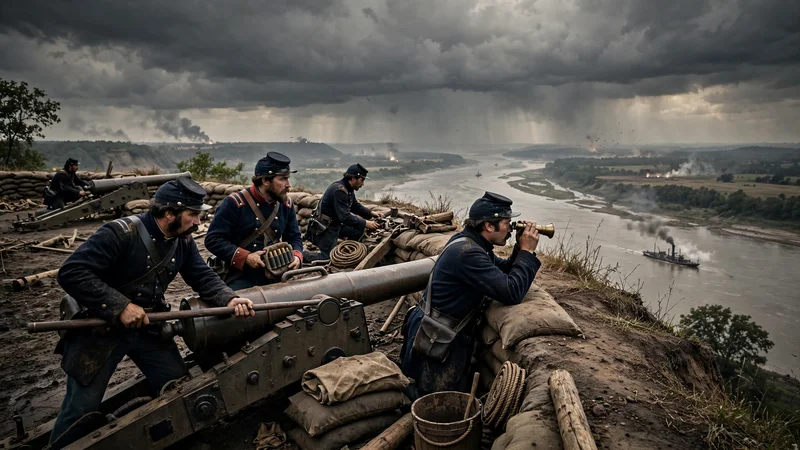
On the morning of July 18, the bombardment began. Warships offshore, including the ironclad USS New Ironsides and the monitors, joined the land batteries, and for eleven hours they poured shells into Fort Wagner. One modern account puts the total at about 9,000 shells. That sounds like a lot. It was a lot. And it barely mattered. The sand swallowed the shells the way it was built to. The fort's guns were mostly still firing when the bombardment lifted, and the men inside were mostly still alive, waiting in their bombproof shelters.
Here is the thing about a sand fort. Brick forts crack. Sand forts shrug. Gillmore's guns had turned Fort Pulaski's brick to rubble in a day, and he seems to have assumed Wagner would go the same way. It did not. The Confederates under Brigadier General William B. Taliaferro had about 1,800 men in the fort, and they came out of their shelters once the firing stopped and manned the parapet. Then Gillmore gave the order anyway.
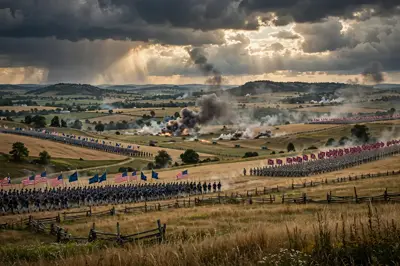
The assault force was about 5,000 men, under Brigadier General Truman Seymour. The 54th Massachusetts would go first, about 600 men in the lead. Behind them came nine more regiments, about 4,400 men in all, including the 6th Connecticut, the 48th New York, and the 3rd New Hampshire. The approach was a strip of beach between the Atlantic on one side and a salt marsh on the other, so narrow that the whole attack had to funnel down it in a column, straight into the fort's guns. There was no way around. There was only through.
The Charge: 7:45 p.m., July 18
The attack went in at dusk, around 7:45 in the evening. Shaw was on foot at the head of his regiment, and the order was simple. Forward. The 54th went from a walk to a run across open sand, with the fort's guns firing down the length of the beach and musketry pouring from the parapet. Men fell in the open. The column kept coming. They reached the ditch, crossed it under fire, and started up the parapet, a wall of sand about thirty feet high, with Confederates shooting down at them from the top.
Think about that climb for a second. You are running uphill through loose sand, in the dark, while men above you fire rifles into your face. Your colonel is ahead of you, on foot, with a sword. No cover. No pause. Just the wall and the men on top of it. And the 54th climbed it. They reached the top. That alone would have been something. What happened next is why we still talk about it.
What Happened on the Parapet
Shaw reached the crest of the parapet with his sword raised, shouting his men forward. He was shot dead almost as soon as he got there. The fighting on top of the parapet turned into hand-to-hand work, bayonets and rifle butts in the dark. The 54th held a corner of the fort for a little while. But the regiments behind them piled into the same narrow space, the attack lost its shape, and Confederate reinforcements ferried across from Charleston during the night sealed the breach. In under an hour, the assault was broken. The Union withdrew, leaving its dead where they fell. Seymour was wounded. The 54th's second in command, Lieutenant Colonel Edward Hallowell, was wounded too, and took command of what was left.
And here is the honest downside nobody should skip. The charge failed. The fort did not fall that night. It would not fall for another 51 days. Tactically, July 18 was a Union defeat, full stop, and the men who died on that parapet died for ground the Union did not hold when the sun came up. If you only count ground, Fort Wagner was a waste of 1,515 men. But wars are not only counted in ground. Keep reading.
The Flag That Never Touched the Ground
The most famous moment of the night belonged to a sergeant. William H. Carney was born enslaved in Norfolk, Virginia, and escaped to freedom through the Underground Railroad, settling in New Bedford, Massachusetts. When the regiment's color-bearer went down on the parapet, Carney seized the flag. He carried it to the top of the parapet and then carried it back to the Union lines, wounded several times, refusing to let it touch the ground. His own words afterward were plain: the old flag never touched the ground. In 1900, Carney received the Medal of Honor for that night, the first African American to receive it.
Shaw's own ending was crueler, and it backfired on the men who ordered it. The Confederates threw his body into a mass trench with his men, meaning it as an insult, a white officer buried with Black soldiers. His father, Francis George Shaw, answered that his son would not have wanted to be separated from his men. The insult became a monument. The sculptor Augustus Saint-Gaudens spent fourteen years on the memorial to Shaw and the 54th, and it was unveiled on Boston Common on May 31, 1897. It is still there. Go look at it if you ever get to Boston.
The Cost, Counted Honestly
The Union lost 1,515 men killed, wounded, or missing out of about 5,000 engaged, according to Encyclopaedia Britannica's account of the battle. The Confederates lost 174 out of about 1,800. That is roughly nine Union casualties for every Confederate one, and the Union still did not take the fort. The 54th itself lost about 270 men out of the roughly 600 who went in, around 42 percent of the regiment, per the National Park Service. Nearly every officer in the regiment was killed or wounded. Colonel Shaw was dead. Two captains were missing and presumed killed. Hallowell was wounded. The regiment that marched onto Morris Island that morning came back a skeleton.
Add the July 11 attack, about 340 more Union casualties, and the week cost the Union close to 1,900 men for a stretch of sand it did not hold. Those are the numbers. They are bad numbers. So what did all that blood buy? That is the question the next section answers, and it is the reason this battle is still taught in schools.
Why a Defeat Changed the War
The charge failed, and the charge worked. Both things are true. Before Fort Wagner, the argument against Black soldiers was that they would not fight. After Fort Wagner, that argument was dead, and everyone knew it. The Northern newspapers that had mocked the idea of Black regiments now printed the story of the 54th on their front pages. Recruitment surged. By the end of the war, about 180,000 Black men had served in the Union Army, roughly one in ten Union soldiers, and about 40,000 of them died. The National Park Service credits the 54th's assault with helping inspire that enlistment, and Lincoln himself recognized Black enlistment as essential to victory. The fort was a defeat. The example was a victory, and it mattered more.
It was quite a month. Gettysburg ended on July 3, Vicksburg fell on July 4, and Fort Wagner came on July 18. Three Union turning points in sixteen days, and only one of them was a defeat. But the defeat is the one that changed who got to fight the war.
The fort itself fell eventually, just not the way Gillmore planned. After 51 more days of siege and bombardment, the Confederates evacuated Fort Wagner on the night of September 7, 1863, slipping away to Charleston. Union guns on Morris Island then pounded Fort Sumter into rubble and shelled Charleston itself. The city held out until February 1865, but its harbor was closed and its great fort was a ruin. And the regiment that had bled on the parapet stayed in the fight. The 54th served on in South Carolina and Florida, and its men finally got their equal pay, backdated to cover the months they had refused it.
The story did not end in 1863. It got retold, and each retelling made it bigger. The 1989 film Glory put the charge on screen for a new generation, and Denzel Washington won an Academy Award playing a soldier of the 54th. The Shaw Memorial on Boston Common is still one of the most visited monuments in America. And the lesson of that night still holds. A battle can be lost and still change a war, if the people who fought it prove something the other side said was impossible.
A Note on the Numbers
A word of caution before you quote any of these figures. The sources disagree, and the disagreements are honest ones. The 54th's casualties are usually given as about 272 out of roughly 600 men engaged. The National Park Service says more than 270 out of 650, about 42 percent. Hallowell's own after-action report, printed in the Official Records, lists 256 enlisted casualties, 9 killed, 147 wounded, and 100 missing, plus the officers. The difference comes down to who was counted and when. The Union total of 1,515 and the Confederate total of 174 follow Encyclopaedia Britannica. The 9,000 shells figure comes from a modern regimental history. None of this changes the story. The assault went in at dusk, Shaw died on the parapet, the fort held, and the regiment lost about two men in five.
3 Lessons from Fort Wagner
Fort Wagner is a defeat, but it is also a manual for what courage actually costs. Three lessons worth keeping:
1. Courage is proven, not declared. The 54th did not argue its case in a newspaper. It ran at a fort in the dark. Every debate about whether Black men would fight ended the moment those men reached the parapet. If you want to settle an argument about what you can do, do the thing. Talk is cheap, and everyone knows it.
2. A defeat can still win the argument. July 18 was a tactical loss, and it changed the war anyway, because it proved the one thing the skeptics said could not be proven. The ground did not matter. The example did. If you ever lose a fight that proves your point, you have not really lost.
3. Don't mistake sand for a soft target. Gillmore had cracked a brick fort in a day and assumed a sand fort would fall faster. It did not. The material matters more than the plan, and the plan has to fit the thing it is aimed at. Nine thousand shells did not move Fort Wagner. Fifty-one days of siege did. Patience beat firepower, and that is worth remembering the next time a quick fix looks tempting.
If you want to see what this battle left behind, start on Boston Common, where the Shaw Memorial still stands. Then read Luis Emilio's regimental history, A Brave Black Regiment, written by a captain who was there. And if you ever get to Charleston, take a boat past Morris Island. The fort itself is gone, eaten by the sea, but the harbor is still there. Stand on the water and look at that narrow strip of sand, and ask yourself if you would have run at it in the dark. The men of the 54th did. That is the whole story, and it is enough.
Sources
- U.S. National Park Service, 54th Massachusetts Regiment
- BlackPast.org, The Second Battle of Fort Wagner (1863)
- Encyclopaedia Britannica, Second Battle of Fort Wagner (1863)
- Library of History, "The Dear Old Flag Never Touched the Ground"
- Conflict & Courage, Battle of Fort Wagner: The 54th Massachusetts Charge
- Luis F. Emilio, A Brave Black Regiment (1891)