The Union won. On 4 July 1863, Confederate General John C. Pemberton surrendered the city of Vicksburg, Mississippi, to Ulysses S. Grant after a siege that lasted about six weeks. Some 29,000 Confederate soldiers gave up. It came just one day after the Union victory at Gettysburg, and together the two wins are usually seen as the moment the Civil War tipped.
Why Vicksburg Mattered So Much
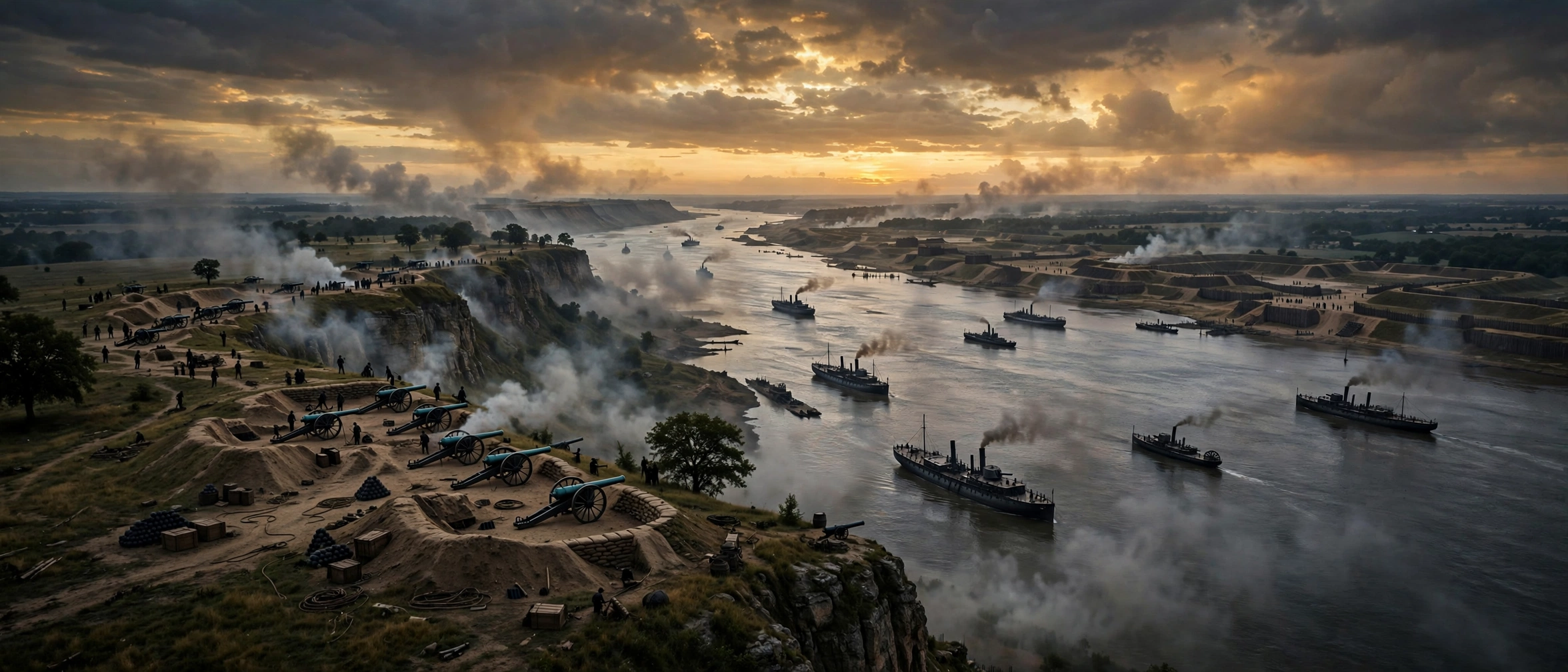
The city sat on a high bluff over a sharp bend in the Mississippi River. Whoever held it controlled the river, and the river was the highway of the American interior. The ironclad warships that made river control possible had proved themselves a year earlier at Hampton Roads. Lincoln understood this well. He's often quoted as saying Vicksburg was the key to the whole war, and that the war couldn't be won without it.
For the Confederacy it was the link between the eastern states and Texas, Louisiana and Arkansas, which supplied men, food and horses. Cut that link and the South was split in two.
Timing multiplied the blow. Vicksburg surrendered on 4 July 1863, one day after Robert E. Lee's army was beaten at Gettysburg in Pennsylvania. Either defeat alone would have been a disaster; landing in the same week, they are why historians so often point to the first days of July 1863 as the turning point of the Civil War. Gettysburg stopped the Confederacy's advance. Vicksburg removed its lifeline, and a cause that could no longer feed or move its armies west of the Mississippi could only delay the end.
Grant Tries Again and Again
Grant spent months trying to get at the city. Several attempts through the swampy ground north of Vicksburg failed. Canals, bayous and river routes all went nowhere. Many in the North wanted him gone.
So in the spring of 1863 he tried something that looked risky. He marched his army down the west side of the river, then had gunboats and transports run past the Vicksburg batteries at night. After that he crossed the river south of the city, near Bruinsburg, on 30 April.
What came next was fast. Grant cut loose from his main supply line and moved quickly through Mississippi. His army won at Port Gibson, Raymond and Jackson, then beat Pemberton in a hard fight at Champion Hill on 16 May. The Confederates pulled back into Vicksburg's defenses.
The Siege
Grant hoped to take the city right away. He ordered assaults on 19 May and again on 22 May, and both failed with heavy losses. So he changed course and settled in for a siege.
Union troops dug trenches closer and closer to the Confederate lines. Gunboats and artillery shelled the town day and night. Inside, soldiers and civilians were running short of food. People dug caves into the hillsides to hide from the shells, and rations got thinner every week. Disease spread through both armies in the Mississippi summer heat.
On 25 June the Union blew a mine under one of the Confederate forts, and the fighting there was fierce. It didn't break the line, but it showed the end was coming. Pemberton knew help wasn't on the way. On 3 July he asked Grant for terms, and on 4 July the surrender was made official.
Life Under Siege: The Cave Dwellers of Vicksburg
For the roughly 3,000 civilians still in Vicksburg, the siege was not a spectacle to watch from a safe distance. It was something they lived inside, day and night, for 47 days. Union siege guns and the mortar boats on the river shelled the town around the clock, and the only real shelter was underground. The town's hills are made of loess, a soft yellow clay that holds a tunnel's shape remarkably well, and families dug into the hillsides behind their houses. By commonly cited counts, some 500 caves honeycombed the bluffs before the siege ended, and soldiers joked that Vicksburg had become a prairie-dog town: empty streets above, a whole population living below.
Some of these refuges were crude burrows barely big enough to crouch in. Others were small underground homes, with two or three rooms, shelves and niches cut into the clay walls, carpets laid on the floors and furniture carried down from the houses above. A well-placed cave, deep enough to be safe from shells, was valuable property, and rents for the safest ones rose sharply as the bombardment went on. Two women left accounts that historians still quote. Mary Ann Loughborough, who sheltered in a cave with her young daughter, published My Cave Life in Vicksburg in 1864, describing meals cooked at the cave mouth between bombardments and a shell bursting at her entrance, close enough to shower the family in loose earth. Emma Balfour, whose house stood within range of the guns, kept a diary of the siege, recording the near-constant shelling and the strange discipline of ordinary life carried on to the sound of artillery.
Hunger became the siege's second weapon. Flour and cornmeal ran out, and bakers produced a gritty substitute loaf from ground peas that the soldiers called pea bread. Fresh beef disappeared, then salt pork grew scarce, and by the final weeks mule meat was being served in the town's hotels without much embarrassment; there are grimmer accounts of rats being eaten as well. Even newsprint ran out: the Daily Citizen printed its last issues on the back of wallpaper, joking in print about the luxury of mule meat, and its final edition, dated 2 July, mocked Grant's reported promise to dine in the town on the Fourth of July. When Union troops occupied the town two days later, their printers added a short triumphant postscript beneath the taunt and ran off copies on the same wallpaper. For all the shells that fell on the town, recorded civilian deaths from the shelling were remarkably few, a fact contemporaries credited to the caves. Disease, hunger and exhaustion took the heavier toll, on the people in the caves and on the soldiers in the trenches alike.
Why the Union Won
Control of the river. Union gunboats kept supplies coming and cut Vicksburg off from the water. A bold plan. Grant's move down the west bank and across the river caught the Confederates off guard. Numbers and supplies. Once the siege began, the Confederates couldn't be resupplied and eventually ran out of food. No rescue. Confederate forces elsewhere in Mississippi were too weak to break the siege.
What Happened After
With Vicksburg gone, the Confederates' last major river fortress, Port Hudson in Louisiana, surrendered a few days later, on 9 July. The whole Mississippi was now in Union hands. The South was cut in two, and the war in the West was effectively decided.
Grant's reputation soared. Within a year Lincoln put him in charge of all Union armies. The city itself, meanwhile, held a long grudge. Many people in Vicksburg are said to have avoided celebrating the Fourth of July for generations.
Why It's Still Remembered
People talk about Gettysburg more, but a lot of historians argue Vicksburg did more to decide how the war would end. One battle stopped Lee's invasion of the North. The other took away the Confederacy's lifeline.
Looking for more? Read our article on the Battle of Agincourt, dig into 10 facts about the Battle of Vicksburg, or browse the rest of Echoes of Battle for other fights that changed history.