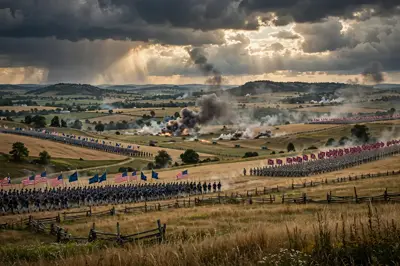
At 4:30 on a dark April morning, the sky over Charleston Harbor lit up. People in the city rushed to their roofs to watch. They thought they were watching a show. They were watching a country break apart.
You have probably heard that Fort Sumter started the Civil War. That's true, and it is also the least interesting thing about it. The interesting part is how small it was, how avoidable it looked from the inside, and how fast a war nobody had yet fought became a war nobody could stop.
The Battle of Fort Sumter was the opening fight of the American Civil War, fought April 12 to 13, 1861, in Charleston Harbor, South Carolina. Confederate batteries shelled the Union-held fort for 34 hours until Major Robert Anderson surrendered his starving garrison of about 85 men. Nobody died in the bombardment, yet shots ended any hope of a peaceful split.
Why Was a Brick Fort in a Harbor Worth a War?
Fort Sumter wasn't a great fortress. It was a five-sided brick fort on a man-made island at the mouth of Charleston Harbor, begun in 1829 and still unfinished when the war started. It was named for Thomas Sumter, a Revolutionary War general from South Carolina. The fort was built to hold 135 guns against enemy ships. Against ships, it would have been a hard target. Against guns on land, all around it, it was a trap.
That trap is the whole story. South Carolina had left the Union on December 20, 1860, weeks after Abraham Lincoln won the presidency. By February 1861, six more states had followed, and they had formed the Confederate States of America. But federal forts still sat inside Southern harbors, flying the United States flag. To Charleston, that flag was an insult. To Washington, giving it up meant admitting the split was real.
So a brick fort became a test. Whoever blinked first would lose face in front of the whole country. And nobody blinked. If you want to understand the Civil War, start here, not with the big battles. The war began as a staring contest over real estate.
How Did 85 Men End Up Alone in Charleston Harbor?
Major Robert Anderson was a 55-year-old Kentuckian, a professional soldier, a slaveholder from a border state, and a man caught between two loyalties. In December 1860 he commanded a small federal garrison at Fort Moultrie, on Sullivan's Island at the edge of Charleston Harbor. Moultrie sat on land. It could be stormed. Anderson didn't like that math.
On the night of December 26, 1860, Anderson moved his men by boat, quietly, to Fort Sumter in the middle of the harbor. The move shocked Charleston. South Carolina called it a hostile act. Anderson called it common sense. He had put water between his men and a surprise attack, and he had put the United States flag on an island nobody could walk up to.
But the move also stranded him. Anderson had roughly 80 to 85 soldiers, plus a handful of civilian workmen who had been building the fort. His food ran low through the winter. His ammunition was short, and much of it was the wrong kind for the guns he had. By April 1861, Anderson told Washington he could hold out only until about April 15, and then only on short rations. He wasn't being dramatic. His own later telegram says that by the end, four barrels and three cartridges of powder were all he had left, and no provision but pork remained.
And here's the part people skip. Anderson's opponent knew him well. Confederate Brigadier General P. G. T. Beauregard had been Anderson's student at West Point. Teacher against student, across a harbor, with the whole country watching. History loves that kind of symmetry. The men living it probably didn't.
What Did Lincoln Actually Send, Food or an Army?
Lincoln took office on March 4, 1861, with a problem no speech could fix. If he abandoned Fort Sumter, the Union looked dead. If he reinforced it with troops, the South would call it an invasion, and the border states might walk out too. So Lincoln picked a third path: clever, but also a gamble.
He sent food. On April 8, 1861, Lincoln's message reached South Carolina Governor Francis Pickens: an expedition would provision Fort Sumter, with provisions only, and no men, arms, or ammunition unless the fort was attacked or resisted. The relief expedition, organized by Gustavus Vasa Fox, waited outside the harbor bar with supply ships and warships. The message was honest. It was also a trap of its own kind.
Look, think about it from Jefferson Davis's side for a minute. If the food got through, the fort could hold out for months, and the Confederacy would look powerless in its own harbor. If Davis fired on a food shipment, the North would call it an attack on a peaceful mission. Davis chose to fire. On April 11, Beauregard demanded the fort's surrender. Anderson refused. Beauregard asked whether Anderson would evacuate by April 15 if not resupplied, and Anderson's answer left enough doubt that Davis ordered the demand repeated, with firing to follow if refused.
Honestly, this is the part where both sides get to claim they were forced into it, and both sides are partly right. Lincoln forced Davis to choose between humiliation and shooting. Davis chose shooting. That choice is what we call the start of the war.
What Happened at 4:30 in the Morning?
Shortly after 3 a.m. on April 12, 1861, Beauregard's aides rowed out to Fort Sumter and told Anderson the batteries would open fire within the hour. Anderson knew what was coming. He had known for weeks.
At 4:30 a.m., Confederate batteries around the harbor opened fire. Guns at Fort Moultrie, at Cummings Point, at Fort Johnson, and a floating battery all joined in. Historians put the Confederate total at more than 40 guns and mortars, firing roughly 3,000 shells over the next day and a half. Charleston residents, including diarist Mary Chesnut, rushed to rooftops in the dark to watch shells arc over the water and burst inside the fort.
Anderson held his fire for hours. Then the fort answered back, sparingly, because every cartridge counted and the fort's guns couldn't do much damage to batteries spread all around the harbor. The fort was built to fight ships coming through the channel. It wasn't built to fight a ring of land batteries lobbing shells over its walls and into its parade ground.
By the morning of April 13, the officers' quarters were on fire. The fire threatened the main powder magazine. The fort's flagpole was shot down, and before the garrison could raise a replacement flag, Confederate officers arrived asking whether the flag being down meant surrender. It didn't, not yet. But Anderson could see where this was going. He had no food worth the name, no powder worth the name, and a burning fort around him.
On the afternoon of April 13, Anderson raised a white flag. Terms were settled that evening, and they were generous: the garrison would evacuate with its flag, its arms, and the honor of a salute. Beauregard, whatever else you say about him, didn't want a massacre. He wanted the fort.
Why Did Nobody Die in a 34-Hour Bombardment?
This is the strangest fact in the whole story, and it is true. Nobody on either side was killed during the 34-hour bombardment. The National Park Service account of the battle records the same result: the bombardment ended with no battle deaths, and the first fatalities came later, by accident.
Why? A few reasons, and none of them are mysterious. The garrison spent most of the bombardment inside thick brick casemates, not standing on open walls. The Confederate guns were firing at long range, across water, at a fort whose walls were built to take punishment. And Anderson kept his men off the exposed upper tier once the shelling got heavy, which cut his casualties to almost nothing.
But don't mistake a bloodless bombardment for a harmless one. The fort was wrecked. The officers' quarters burned. The gorge wall was badly injured. The magazine was surrounded by flames. Anderson's telegram of April 18, 1861, written from the relief ship Baltic, lists the damage in plain soldier's language: quarters entirely burned, main gates destroyed by fire, magazine surrounded by flames. A fort can be destroyed without a man dying in it. Fort Sumter proves it.
And here's the honest downside of the Fort Sumter story, if you came looking for a great battle. As a fight, it was small, one-sided, and tactically dull. No brilliant maneuver decided it. No charge broke a line. The fort was outnumbered, outgunned, and starving before the first shell was fired. Its importance isn't military. It is political, and politics is what made the next four years so bloody.
The Salute That Killed the First Men of the War
Anderson's one condition for leaving was a salute to the United States flag: 100 guns. Beauregard agreed. On the afternoon of April 14, 1861, the garrison gathered to fire it, using cartridges improvised from scrap flannel because proper cartridge bags were gone.
The salute had reached about the 47th gun when a spark set off a cartridge early. The explosion killed Private Daniel Hough, an Irish-born soldier of the 1st United States Artillery, and wounded the rest of his gun crew. Private Edward Galloway was mortally wounded and died a few days later in a Charleston hospital. Anderson stopped the salute at 50 guns.
Think about that for a second. The first men to die in the American Civil War didn't die from enemy fire. They died firing a salute to their own flag, in a ceremony meant to honor a surrender. Hough was buried in the fort's parade ground within hours. Galloway followed days later. The garrison then boarded a steamer, transferred to the relief ship Baltic outside the harbor, and sailed north carrying the same flag Anderson had defended.
That flag became a symbol. Anderson carried it north, and crowds turned out to see it. Four years later, on April 14, 1865, Anderson himself returned to Fort Sumter and raised that same flag over the ruins, in a ceremony marking the fort's return to Union hands. That night, in Washington, Abraham Lincoln was shot at Ford's Theatre. The war's first flag and the war's last day share a date. Nobody planned that. History just does that sometimes.
So Who Really Started It?
Most people get this wrong, or at least too simple. The Confederates fired first, that is a fact, at 4:30 a.m. on April 12, 1861. But "fired first" and "started the war" are not quite the same question, and historians still argue about the gap between them.
Here's the fair version. South Carolina seceded first, in December 1860, and demanded federal property it didn't own. The Confederacy formed itself around that demand. Lincoln refused to surrender the fort, and then sent a food shipment that forced Davis to either accept a Union fort in Charleston Harbor or fire on it. Davis fired. Each side took a step the other side could call aggression, and each step made the next one harder to avoid.
Honestly, Fort Sumter is overrated as a battle and underrated as a warning. It shows how two governments can talk themselves into a war neither army is ready to fight, by turning a small, symbolic place into a test of honor. The men inside the fort understood that better than the politicians did. Anderson and Beauregard, teacher and student, exchanged polite letters while their guns were being loaded. Politeness didn't stop the shells.
What happened next was fast. On April 15, 1861, Lincoln called for 75,000 volunteers from the state militias, to serve for three months. The call pushed four more states, Virginia, Arkansas, Tennessee, and North Carolina, out of the Union and into the Confederacy. The war that began with zero battle deaths at Fort Sumter would kill more than 600,000 soldiers before it ended. That gap, between the quiet bombardment and the slaughter that followed, is the real story of Fort Sumter.
What Fort Sumter Teaches You About Staring Contests
So what do you take from a battle where nobody died in the fighting? Three things, and they are all practical.
First, symbols matter more than their size. A half-finished brick fort with 85 hungry men inside should not have decided the fate of a continent. It did, because both governments had decided it would. If you ever find yourself in a standoff, ask what the place, or the point, is actually worth, before you let pride price it for you.
Second, a "peaceful" move can still force a war. Lincoln's food-only shipment was honest, limited, and legal. It also left Davis with no good option. Good intentions don't cancel out consequences. Anderson saw that clearly. The politicians, on both sides, saw only the next move.
Third, the first casualty isn't always the enemy's fault. Hough and Galloway died by accident, in their own ceremony, and their deaths remind you that war kills people in stupid, pointless ways from the very first day. The bombardment spared everyone. The salute didn't. If that doesn't sober you up about war, nothing in this article will.
And one last thing. If you visit Charleston today, you can take a boat out to Fort Sumter, now a national monument run by the National Park Service. The walls are lower than they were in 1861, battered by three more years of Union shelling after the Confederates took the fort. Stand on that island and look back at the city. The harbor is beautiful. It is also, still, a reminder: a country can break apart over a place you could walk across in five minutes, if the people in charge decide that place means everything.
Sources
- National Park Service, Battle of Fort Sumter, April 1861
- Major Robert Anderson, telegram from the steamship Baltic, April 18, 1861 (quoted in National Park Service and Wikipedia accounts of the battle)
- New York Division of Military and Naval Affairs, New Yorker Was First Casualty of the Civil War: Private Daniel Hough
- Wikipedia, Battle of Fort Sumter