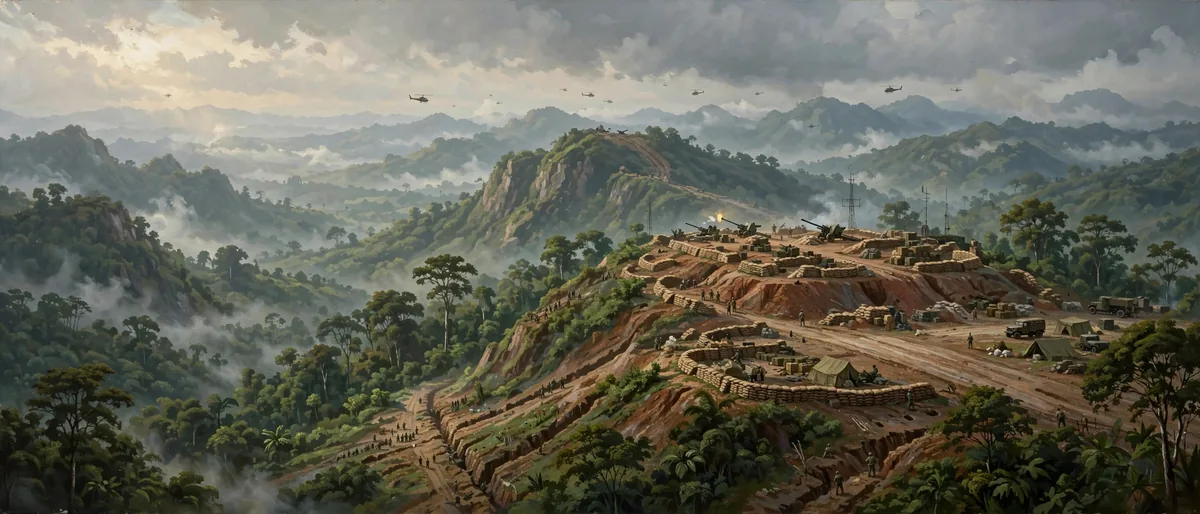
Picture this. It is January 1968, and about 6,000 US Marines are sitting on a red dirt plateau in the far northwest corner of South Vietnam. The fog is so thick you can barely see the next bunker. The hills around them belong to the enemy. And somewhere out there in the jungle, roughly 17,000 North Vietnamese soldiers are digging in for a siege. The Marines are about to spend 77 days under shellfire, and back home in America their fight is about to become the most famous battle of the whole Vietnam War. This is Khe Sanh. And the real story is stranger than the legend.
Why Was Anyone Fighting Over a Dirt Airstrip?
Start with the map, because the map is the whole reason Khe Sanh existed. The base sat on a plateau about 1,500 feet up, in Quang Tri Province, some 10 miles south of the Demilitarized Zone and about 6 miles from the Laos border. Route 9, the only decent road in the area, ran right past it. And just over the border in Laos ran the Ho Chi Minh Trail, the supply road that kept the whole North Vietnamese war effort moving south.
General William Westmoreland, the American commander in Vietnam, wanted a base there for three reasons. It could watch the trail. It could launch patrols into the hills. And if the North Vietnamese came for it in force, it could trap them under American airpower. He had a phrase for the idea. He wanted a Dien Bien Phu in reverse.
That phrase needs unpacking, because it tells you how Westmoreland was thinking. In 1954 the French had lost Dien Bien Phu when the Viet Minh surrounded their base and shelled it for 55 days until it fell. Westmoreland looked at that defeat and saw it backwards. Give the enemy a base to surround, he thought, and then bury his army under bombs while your own men sit safe in bunkers. The French had lost because they could not supply their base or bring enough firepower to bear. The Americans, with their bombers and helicopters, would not have that problem.
There was a warning sign, and it came a year early. In the spring of 1967 the Marines fought a series of bloody fights for the hills around the base, Hills 861, 881 South, and 881 North. They took the high ground, but it cost them. The North Vietnamese were already there, in strength, and they were not going away. If anyone in Saigon had doubts about holding Khe Sanh, those hill fights should have settled them.
Honestly, the base was a trap that both sides thought they were setting. That is the first thing to understand about Khe Sanh. Westmoreland wanted Giap to attack it. Giap wanted Westmoreland to defend it. Both men got exactly what they wanted. Neither got what he expected.
Who Actually Fought at Khe Sanh?
The American garrison was the 26th Marine Regiment, commanded by Colonel David E. Lownds, a steady officer who had been given the one job nobody envied. By January 1968 the base held about 6,000 men. Three battalions of the 26th Marines formed the core, reinforced by the 1st Battalion, 9th Marines, plus Army artillerymen and a handful of South Vietnamese Rangers. They had a 3,900-foot airstrip of crushed rock, bunkers, trenches, sandbags, and barbed wire. That was home.
Ringing the base were two full North Vietnamese divisions, the 304th and the 325C, about 17,200 men in the immediate siege force, with two more divisions, the 320th and 324th, working the Route 9 corridor behind them. The overall commander was General Vo Nguyen Giap, the man who had beaten the French at Dien Bien Phu. His field commander on the ground was Tran Quy Hai. The North Vietnamese brought Soviet-made 130mm guns, 122mm rockets, and 82mm mortars, weapons that could reach the base from hills the Marines did not hold.
Do the math and the picture is stark. Nearly three attackers for every defender. And the attackers held the high ground. The Marines had one edge, and it was a big one. They had the sky. Everything that happened over the next 77 days comes down to whether that edge was enough.
January 21, 1968: The Morning the Sky Fell In
Before dawn: the barrage opens. At about 5:30 in the morning on January 21, North Vietnamese artillery opened fire on the base. The first shells found an ammunition dump near the airstrip. Around 1,500 tons of shells and grenades went up in one blast. Eighteen Marines were killed and 40 wounded on the first day, before the sun was properly up.
The days after: the shelling never stops. It settled into a routine, and routine is the wrong word for it. Some days were quiet. Some days were not. On February 23 the enemy fired more than 1,300 rounds at the base in a single day. The Marines lived underground, in bunkers and trenches, coming out to repair the airstrip, man the wire, and wait for the next barrage. The fog rolled in most mornings and stayed until noon. When it lifted, the shelling usually started again.
February 6 to 7: Lang Vei falls. Seven miles west of the base, a small Special Forces camp at Lang Vei was overrun. North Vietnamese infantry attacked behind PT-76 light tanks, the first time the North Vietnamese had used armor in the war. The camp fell in a night. Its survivors fought their way to Khe Sanh. The message was plain. The siege force had tanks, and it was not afraid to use them.
Life inside the wire was miserable in ways that do not show up in casualty figures. The red mud got into everything. Rats ran through the trenches. The men ate cold rations, slept in shifts, and wrote letters home that said very little about what was really happening. And every day, the question hung in the air. When would the big ground attack come?
It never came. Not the way everyone expected. That is one of the strangest facts about Khe Sanh. For all the shelling, for all the troops massed around the base, the North Vietnamese never launched the full frontal assault on the main perimeter that Westmoreland had been waiting for. They probed, they shelled, they attacked the hill outposts. But the great storming of the base never happened. Some historians think Giap never meant to take it by assault. Others think the bombing broke his timetable. Nobody knows for sure, and that argument is still going.
What Kept 6,000 Men Alive for 77 Days?
The short answer is airplanes. A lot of airplanes. The air campaign to save Khe Sanh was called Operation Niagara, and its numbers still stop people cold. On an average day, about 350 tactical fighter-bombers, 60 B-52s, and 30 reconnaissance aircraft worked the skies around the base. In the first three months, American and allied aircraft dropped more than 100,000 tons of bombs in defense of the base, 114,810 tons by the official count, and Marine and Army gunners fired more than 158,900 artillery rounds back at the hills.
The B-52s did the heaviest work. They dropped about 59,000 tons of bombs out of a total of roughly 98,000 tons dropped by all aircraft in the Khe Sanh area, flying from Guam and Thailand in strikes so close to the base that American troops were bombing targets less than a mile from their own wire. The historian John Morocco called it the most concentrated application of aerial firepower in the history of warfare. He was not exaggerating. About 1,300 tons of bombs fell on the area every day.
But bombs alone do not feed 6,000 men. The airstrip was the lifeline, and keeping it open was a fight of its own. C-130 and C-123 transport planes flew in when the weather allowed, and when the shelling made landing too risky, they dropped supplies by parachute or by low-altitude extraction, skimming the runway and yanking pallets out the back. Between March 31 and April 8 alone, transport aircraft delivered 843 tons of supplies to the base by paradrop and low-altitude drops. The men on the ground called the supply planes their angels. They were not joking.
And the Marines dug in like men who meant to stay. Bunkers went deeper. Trenches got roofs. Sandbags piled up by the hundred thousand. The base became a small underground city, and that is what saved it. Shells that would have shredded an exposed camp mostly hit dirt and sandbags instead. Boring work, unglamorous work, and it is the reason the casualty figures look the way they do.
Was Khe Sanh Just a Trick to Hide the Tet Offensive?
Here is where the story gets complicated. Ten days after the siege began, on January 30 and 31, the North Vietnamese and Viet Cong launched the Tet Offensive, attacking more than 100 cities and towns across South Vietnam, including Saigon itself. The American public, watching it all on the evening news, was stunned. The war they had been told was nearly won had just exploded in every city at once.
So which was it? Was Khe Sanh the real target, with Tet as the sideshow? Or was Khe Sanh the trick, a siege staged to pull American troops north while the real blow fell on the cities?
Westmoreland was sure Khe Sanh was the main effort. He had spent months warning Washington that Giap was massing for a big set-piece battle in the north, a second Dien Bien Phu, and he read the siege as proof he was right. He poured troops and bombers into the area to meet it.
His critics, then and now, read it the other way. They say Giap used Khe Sanh to fix American eyes on a remote hilltop while Tet hit the cities, and that Westmoreland fell for it. Giap himself later said the siege was meant to draw American forces away from the populated areas. But Giap also had reason to say that after the fact, and his own generals disagreed about his intent.
Most people get this wrong. They treat Khe Sanh and Tet as two separate stories. They were one story. The siege fixed American attention on a hilltop while the war exploded in the cities, and the two together broke something in the American public that no single battle could have broken alone. You do not have to pick a side in the historians' argument to see that. The siege and the offensive fed each other, and the American public watched both on the same newscast.
Operation Pegasus: The Road Back Open
By late March, the siege was still going, but the ground was starting to shift. Westmoreland ordered a relief operation, and on April 1 a force of about 20,000 men, the Army's 1st Air Cavalry Division and Marine regiments, moved west along Route 9 from Ca Lu toward Khe Sanh. The operation was called Pegasus.
The relief force found far less resistance than anyone had planned for. The North Vietnamese were already pulling back, slipping away into Laos rather than fight a set-piece battle against a fresh, fully supplied force backed by the same bombers that had pounded them for two months. On April 8 the road was open and the base was relieved. The siege was over. Pegasus formally ended on April 14, and the 26th Marines, who had held the base for 77 days, finally got their chance to walk out of the wire and take the fight to the hills.
The numbers from Pegasus tell their own story. The relief operation flew 45 B-52 strikes and 1,625 tactical sorties in support of the ground troops. And yet the heaviest fighting of the whole relief was over before it started, because the enemy had already decided not to be there. That is the strange anticlimax of Khe Sanh. After 77 days of shelling, the siege ended not with a grand assault or a grand breakout, but with the enemy quietly leaving.
What Did Khe Sanh Cost?
So who won the Battle of Khe Sanh? The honest answer is that both sides claimed victory, and both had something to point at. The Marines held the base. The siege was lifted. The relief force reopened the road. On any normal scorecard, that is a win.
The cost at the base itself was 274 Americans killed and 2,541 wounded. North Vietnamese losses are harder to pin down. American forces counted 1,602 enemy bodies, and American estimates put total North Vietnamese casualties at 10,000 to 15,000. Hanoi's own figure, for the fighting from January 20 to July 20, was 2,469 killed. The gap between those numbers is enormous, and it tells you something about how casualty figures worked in this war. One side counted bodies. The other side counted what it admitted. Neither number is the whole truth.
But here is the part that still stings, and any honest account of Khe Sanh has to say it plainly. After 77 days of holding the base, after all those bombs and all those dead, the Americans gave it up. In June and July 1968 the base was dismantled and abandoned, and the North Vietnamese moved back into the area. The ground that 274 Americans had died to hold was walked away from within three months of the relief.
The military reason was simple enough. Once the siege was over, the base had little value, and holding it tied down troops the Americans needed elsewhere. The political reason was harder to say out loud. A base that had become a symbol of American resolve was suddenly a symbol of American waste. If you ask what the siege was for, that is the question that will not go away. And it is the question that made Khe Sanh famous for all the wrong reasons.
What Is the Battle of Khe Sanh?
The Battle of Khe Sanh was a 77-day siege in 1968, when about 6,000 US Marines held a combat base in northwest South Vietnam against roughly 17,000 North Vietnamese troops. American aircraft dropped more than 100,000 tons of bombs to keep the base alive. The siege ended in April, but the United States abandoned the base three months later.
Why Did Khe Sanh Actually Matter?
So why was the Battle of Khe Sanh important? Really. Not the textbook answer. The real one.
First, it was the most televised siege of the Vietnam War, and television changed what it meant. Every night, Americans watched the same pictures: Marines in trenches, fog, shellfire, a base that might fall at any moment. And at the same time, Tet was burning in the cities. The two stories ran together in the public mind, and together they broke the official line that the war was nearly won. Khe Sanh did not lose the war on the battlefield. It helped lose it in the living room.
Second, it proved something and disproved something at the same time. It proved that American firepower could hold any single piece of ground, no matter how isolated, against any force the enemy could mass. The bombers did their job. The base held. But it also proved that holding ground was not the same as winning the war. The enemy could walk away, come back later, and the ground would still be there. The Americans learned they could win every siege and still lose the war, and that lesson cost them dearly.
Third, the abandonment of the base in July became the battle's lasting image. A victory you walk away from does not feel like a victory, and the American public knew it. The generals could explain the logic all day. The pictures told a simpler story. Men died for a hilltop, and then the hilltop was given back. That is why Khe Sanh still gets argued about, while plenty of bigger battles from the same war are forgotten.
A Note on the Numbers
Honest history comes with asterisks, and Khe Sanh has more than most. The dates are the easy part. The siege ran from January 21 to April 8, 1968, 77 days. Some histories date the battle to July 9, when the base was abandoned, and that is fair too, because the fighting in the area went on after the relief. The troop figures are estimates. The American garrison is usually put at about 6,000 men, and the North Vietnamese siege force at about 17,200, but both numbers moved as units rotated in and out.
The casualty figures are the hard part. The American losses at the base, 274 killed and 2,541 wounded, are solid, drawn from Marine records. The North Vietnamese figures are not. The 1,602 bodies counted is a floor, not a total. The 10,000 to 15,000 estimate is an American intelligence figure, and it counts wounded as well as killed. Hanoi's figure of 2,469 killed covers a longer period and a wider area. None of these numbers can be checked against a single clean source, because both sides had reasons to shape them. The figures used here are the ones most histories agree on, and the gaps are stated, not hidden.
One more thing worth saying plainly. The sources for this battle are mostly American military histories, Marine Corps records, and the memoirs of the men who were there. The North Vietnamese view is thinner in English, and the voices of the Vietnamese civilians who lived around the base are thinner still. That is a gap, not a conspiracy. But it is worth remembering that Khe Sanh was full of people who just wanted the war to go away, and their home was the battlefield.
3 Lessons from Khe Sanh
Khe Sanh is a siege, but it is also a case study in winning the battle and missing the point. Three lessons worth stealing:
1. Firepower can hold ground. It cannot win a war by itself. The bombers saved Khe Sanh. No question about it. More than 100,000 tons of bombs kept 6,000 men alive against an army three times their size. But the enemy walked away, came back later, and the ground was still there. If your strategy is to hold ground, you need a plan for what the ground is for. The Americans never quite had one at Khe Sanh.
2. A siege on television is a political event, not just a military one. Westmoreland fought Khe Sanh as a military problem, and on military terms he solved it. But the battle was fought on American television at the same time, and on those terms it was a defeat. The pictures of Marines under siege, running alongside the pictures of Tet, told the public the war was out of control. Generals who ignore the home front do so at their own risk. Khe Sanh proved it.
3. Ask what the ground is for before you bleed for it. The Marines at Khe Sanh did their job, and did it well. The failure was not theirs. It belonged to the plan that put them on a hilltop with no clear purpose beyond being a target. If a position is worth 77 days of shelling, it should be worth holding in July. And if it is not worth holding in July, someone should have asked that question in January.
Want to see the sieges that make Khe Sanh look short? Our longest sieges in history guide starts with the ones that lasted years, not days. And if you want the war's most famous urban battle, our Battle of Mogadishu 1993 summary covers a fight that lasted one night and changed American policy for a decade.