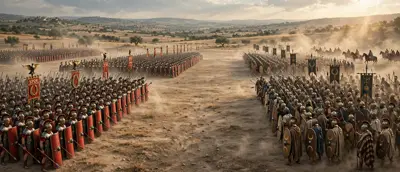
This Battle of Zama summary comes down to one afternoon that changed the ancient world. On October 19, 202 BC, on the dusty plains near Zama Regia in North Africa, two of the greatest generals who ever lived faced each other across the same field for the first and only time. Hannibal Barca. Publius Cornelius Scipio. Sixteen years of war behind them. One of them was about to learn what losing felt like.
Why Did Hannibal Leave Italy?
Here is the thing you have to understand first: Hannibal was winning. Or so it looked. For fifteen years he had been roaming Italy at will, and Rome couldn't stop him. Trebia in 218. Lake Trasimene in 217, an ambush in the fog. And Cannae in 216, the most famous encirclement in military history. Polybius, the Greek historian who wrote the best surviving account of the war, puts Rome's dead at Cannae at around 70,000 men. Seventy thousand. In a single day. Rome never forgot that number, and if you want the backstory, our Battle of Cannae 216 BC summary covers the day the trap closed.
But here is the thing about Cannae: it didn't end the war. Hannibal kept waiting for Rome's Italian allies to desert. Most of them didn't. And Rome, to its credit, refused to die. They adopted the strategy of Quintus Fabius Maximus, the Delayer: don't fight Hannibal's army, just shadow it, harass it, and wait. Boring? Completely. Effective? Ask Rome.
Then came the young man who changed everything. Publius Cornelius Scipio was twenty-four when he took command in Spain in 210 BC, and within four years he had taken New Carthage, beaten Hannibal's brother Hasdrubal at Baecula, and crushed the last Carthaginian army in Spain at Ilipa in 206. Spain was gone. Carthage's money was gone. So Scipio did the obvious thing nobody else had dared: he invaded Africa itself. In 204 BC he landed in Tunisia and marched on Carthage.
And suddenly the war had a deadline.
Carthage panicked. They ordered Hannibal home. After fifteen years in Italy, he sailed for Africa with his veteran army, the men who had crossed the Alps with him and survived everything since. He landed and marched inland toward the Roman camp, then did something nobody expected. He asked Scipio for a meeting. The two commanders met face to face, with only their interpreters present. They talked peace. Scipio's terms were harsh. Hannibal walked away. The next day, they fought.
Who Actually Fought at Zama?
The armies, then, with the honest numbers. Scipio fielded roughly 29,000 infantry and about 6,100 cavalry. Around 35,000 men in total, if you trust Polybius, and most historians do. Hannibal had about 36,000 infantry and only some 4,000 cavalry, plus 80 war elephants. Britannica, working from the ancient sources, puts the two armies at roughly 40,000 men each. Close enough to call it even on foot, which was exactly the problem for Hannibal: the cavalry balance had flipped against him for the first time in the whole war.
Why? Because Numidia had switched sides. Masinissa, the Numidian king, brought his famous horsemen to the Romans. Hannibal's own Numidian cavalry, the arm that had destroyed Roman armies at Cannae and everywhere else, was mostly gone. He had also been forced to slaughter his horses before leaving Italy, since he couldn't transport them across the sea. So the finest cavalry arm in the ancient world belonged to Rome that day.
Let that sink in. Rome. The infantry power. Out-cavalrying Hannibal.
Hannibal's infantry came in three distinct lines. The first line was a mix of Gauls, Ligurians, Balearic islanders, and Moors, mercenaries and levies. The second line held Carthaginians and Libyans, plus about 4,000 Macedonian soldiers sent by Philip V, according to Livy. The third line was the real thing: Hannibal's Italian veterans, 12,000 to 15,000 men who had followed him across the Alps and through sixteen years of campaigning. They stood apart from the other lines. Hannibal was saving his best for last.
A quick honesty note on the battlefield itself: we don't know the exact spot. Livy names it Naraggara. Modern historians place it on the plains near Zama Regia, in what is now Tunisia, not far from modern Jama. The precise field is debated. The battle is not. It happened, and it happened here, give or take a few miles.
What Was Scipio's Elephant Plan?
Everyone feared the elephants. Eighty of them, lined up in front of Hannibal's army, armored and carrying howdahs, and they had already beaten Roman armies before. The standard Roman formation, the checkerboard quincunx, was exactly the wrong shape to receive them: solid blocks of men that a panicking elephant would smash straight through. So Scipio did something nobody had done. He stacked his maniples in columns, one behind the other, leaving wide open lanes between them. Gaps on purpose. An invitation.
Then he filled the gaps with velites, light skirmishers armed with javelins, and he massed his trumpeters behind them. When Hannibal's elephants charged, the Romans blew every horn at once and showered the beasts with missiles. The elephants, already poorly trained according to Britannica's account, panicked. Some veered off and trampled their own Carthaginian lines. The rest charged straight down the open lanes, through the Roman army and out the back, where they were killed or captured. Scipio had refused to give the elephants anything solid to hit, and it worked.
Think about what that took. This wasn't a new weapon or a brilliant improvisation on the day. Scipio had been studying elephants since Spain. He had fought them before. He had thought about them for years. When the moment came, he had a plan so simple it looked like doing nothing: leave gaps. The most dangerous weapon on the field became a non-event. That's what preparation looks like when it meets the moment.
October 19, 202 BC: What Happened That Day
Morning: the elephants fail. Hannibal opened with his eighty elephants and a screen of skirmishers, hoping to smash the Roman center before the real fighting started. The trumpets, the javelins, the lanes: it was over in minutes. The weapon Hannibal had built his opening around was gone. You know the feeling when your big plan dies in the first five minutes? That was Hannibal's morning.
Mid-morning: the cavalry goes. With the elephants gone, the cavalry battle began, and this was the whole war in miniature. On the Roman right, Laelius charged the Carthaginian cavalry. On the left, Masinissa's Numidians hit the Carthaginian horse opposing them. Both Carthaginian wings broke and fled, and both Roman cavalry forces chased them off the field. Gone. For a long, long time, the infantry would fight with no cavalry on either side.
Midday: the infantry grind. Now the two infantry lines met. Hannibal's first line, the mercenaries and levies, fought the Roman hastati, the youngest legionaries. It was brutal, close work, but the Romans pushed them back, and the broken first line fled into Hannibal's second line. The second line refused to let them through, the fugitives fought their way in anyway, and the whole mess collapsed onto Hannibal's veterans. Pause. Breathe. That was the first act.
Afternoon: the pause. This is the part people forget, and it's fascinating. Both sides stopped. Hannibal extended his third line, his veterans, to match the Roman front. Scipio gathered his hastati and principes and triarii into one long single line to face them. The best infantry in the ancient world squared off against the other best infantry in the ancient world. Hannibal's veterans were holding their own. They were arguably winning. The battle hung on a knife edge.
Late afternoon: the hammer falls. Then the Roman cavalry came back. Masinissa and Laelius, having chased the Carthaginian horse off the field, returned and hit Hannibal's third line from behind. That was it. Infantry can't fight in two directions. Hannibal's veterans, who had held for hours, were surrounded and destroyed. Hannibal himself escaped the field with a handful of horsemen and rode for Carthage. The battle was over. The war was over. One afternoon.
Three Moments That Decided Zama
1. The elephants, neutralized. Hannibal opened with his heaviest weapon and Scipio turned it into a parade. The eighty elephants were supposed to break the Roman line. Instead they ran down empty lanes while Roman skirmishers pelted them from the sides. Hannibal's opening gambit produced nothing but noise and a few trampled Carthaginians. Battles are rarely won in the first hour, but they can be lost there, and Hannibal nearly did.
2. The cavalry imbalance. This is the heart of this Battle of Zama summary. Hannibal won every battle in Italy because he had the better cavalry. The Numidian horsemen were his hammer, and Rome had no answer for them for fifteen years. At Zama, Scipio had stolen the hammer. Masinissa's defection flipped the single biggest tactical advantage of the war. Honestly, you could argue the battle was decided the day Masinissa switched sides, months before a spear was thrown.
3. The return of the cavalry. Hannibal's veterans were holding. Let me say that again, because it matters: the third line, Hannibal's best men, was holding its own against Rome's best. If the cavalry had never come back, who knows? But they did come back, and they hit from behind, and an infantry line can't fight in two directions. Zama was won by patience as much as by planning: Scipio's horsemen waited until the exact moment their return would be fatal.
What Did Zama Cost?
So who won the Battle of Zama? Rome. Completely. Polybius reports Roman losses at about 1,500 dead, an almost unbelievably light price for the scale of the victory. The Carthaginian losses were catastrophic: Polybius puts their dead at about 20,000, with some 15,000 taken prisoner. Livy's account pushes the captured figure toward 20,000. Modern historians treat all these numbers with care, but the ratio tells the real story. It was a slaughter.
Those numbers deserve a pause. Twenty thousand men dead in an afternoon, most of them Carthaginian levies and mercenaries who had been dragged into Hannibal's army weeks before and never stood a chance against Roman legionaries. Hannibal's veterans died fighting, to the last. The dead were people, not statistics, and the ancient sources that count them so casually were written by the winners.
What Is the Battle of Zama?
The Battle of Zama was the decisive final battle of the Second Punic War, fought on October 19, 202 BC, near Zama Regia in modern Tunisia. Rome's Scipio Africanus defeated Carthage's Hannibal Barca by neutralizing 80 war elephants and using superior cavalry to destroy the Carthaginian army, ending the war and launching Rome's rise to empire.
Why Did Zama Actually Matter?
So why was the Battle of Zama important? Really. Not the textbook answer. The real one.
First, it ended the Second Punic War on the spot. Carthage sued for peace, and the Treaty of Zama in 201 BC was brutal: Carthage's fleet was cut to ten ships. Spain and all overseas territory were gone. Carthage paid 10,000 talents of silver over fifty years. Masinissa was restored as king of an enlarged Numidia. And Carthage couldn't wage war, inside Africa or out, without Rome's permission. That last clause was the quiet killer. It made Carthage a client state in everything but name.
Second, Zama made Rome. Before Zama, Rome was a powerful Italian republic with a Mediterranean problem. After Zama, Rome was the power of the Mediterranean, full stop. The next two centuries of Roman history, the conquest of Greece, the destruction of Carthage in 146 BC, the whole empire, all of it starts on that plain in Tunisia. If you're looking for the single day Rome became Rome, this is a strong candidate.
And what about Hannibal? He went back to Carthage and actually ran the city well for a few years, reforming its finances with real skill. But Rome never stopped watching him. In 195 BC, fearing Rome would demand his surrender, Hannibal fled into exile. He served the Seleucid king Antiochus III, then King Prusias of Bithynia, always one step ahead of Roman agents. In about 183 BC, cornered at last, he took poison rather than be handed to Rome. He died undefeated in spirit, if not in fact. A very Hannibal way to go.
Here is the honest downside, because history needs one: Rome's victory at Zama taught Rome the wrong lesson. The peace was so complete, the dominance so total, that Rome got used to settling every rivalry by annihilation. Fifty-six years later, Rome would return to Carthage for the Third Punic War and erase the city entirely, selling its people into slavery. Zama didn't just end a war. It rehearsed an empire's habit of finishing its enemies. That's the shadow under the triumph.
A Note on the Numbers
Honest history comes with asterisks, and Zama has its share. The date, October 19, 202 BC, comes from Livy; Polybius, our other great source, gives no exact day. The 80 elephants are Livy's figure and the one most histories use. Casualty numbers are ancient and should be read with ancient-sized skepticism: Polybius's 1,500 Roman dead against 20,000 Carthaginian dead is a suspiciously tidy ratio, though the direction of the result is beyond doubt.
The exact battlefield is uncertain too. Livy calls the site Naraggara. The conventional identification puts it near Zama Regia in modern Tunisia. Some historians have argued for other spots. Nobody has found a battlefield's worth of artifacts to settle it. That's normal for ancient history, not a conspiracy.
What is not in doubt: the commanders, the cavalry imbalance, the elephant tactic, the result, and the treaty that followed. The rest is rounding.
3 Lessons from Zama
Zama is a battle, but it's also a case study in beating someone better than you. Three lessons worth stealing:
1. Steal the enemy's best weapon. Scipio didn't just counter Hannibal's cavalry. He took it. Masinissa's Numidians were the arm that had destroyed Roman armies for fifteen years, and Scipio made them Roman. If your rival has one unbeatable advantage, don't outwork it. Acquire it.
2. Prepare for the scary problem until it's boring. Eighty war elephants would terrify any army on earth. Scipio's answer was lanes, trumpets, and javelins, a plan so simple it looked like doing nothing. He had been thinking about elephants for years before Zama. When the moment came, there was no panic, because the thinking was already done. The scariest problems usually have the simplest answers, if you start early enough.
3. Patience is a weapon. Rome took sixteen years to win this war. Sixteen years of Cannae-level disasters, political chaos, and generals who wanted quick glory. Scipio's whole strategy was refusing to fight Hannibal's kind of battle until the terms were right. Sometimes the boldest move is waiting. And then, when the moment comes, moving fast.
Here is the uncomfortable truth nobody tells you about Zama: Hannibal was probably the better battlefield commander, and Scipio knew it. So Scipio refused to fight Hannibal's kind of battle. He fought his own. That's the real lesson of the day, and it applies far beyond ancient Tunisia.
Want to see where this story started? Our Battle of Cannae 216 BC summary covers the day Hannibal destroyed a Roman army and still lost the war. And if you're ranking the generals themselves, our greatest military commanders guide puts both Hannibal and Scipio where they belong.