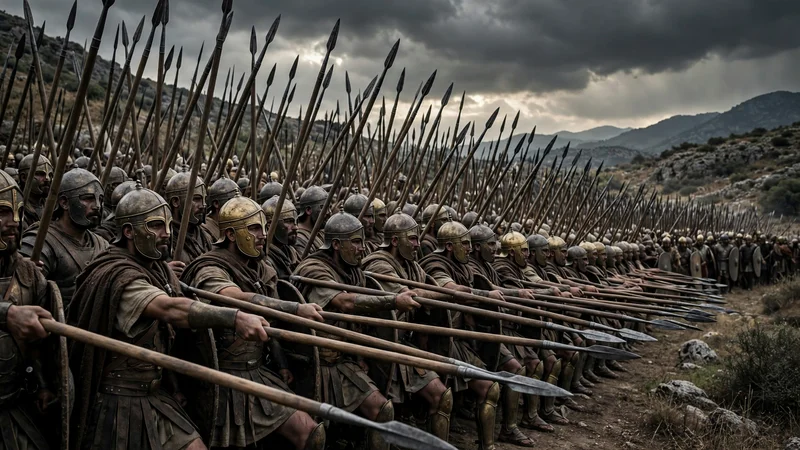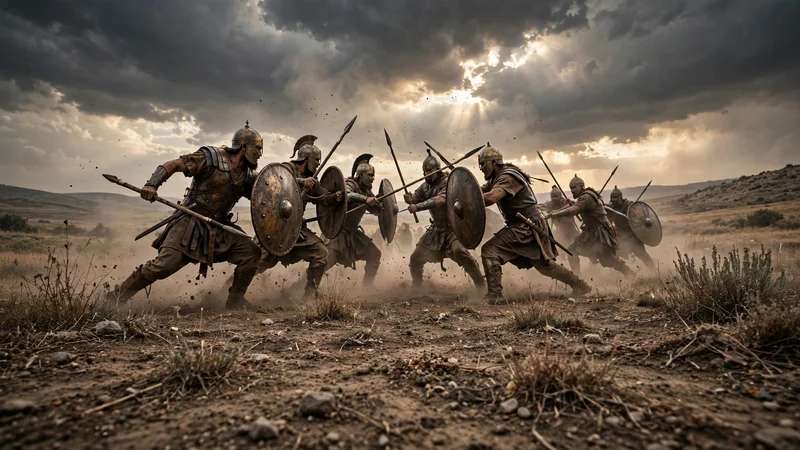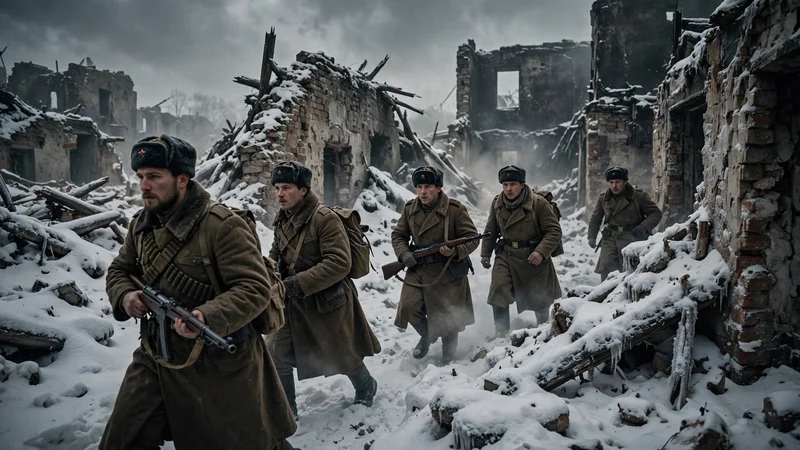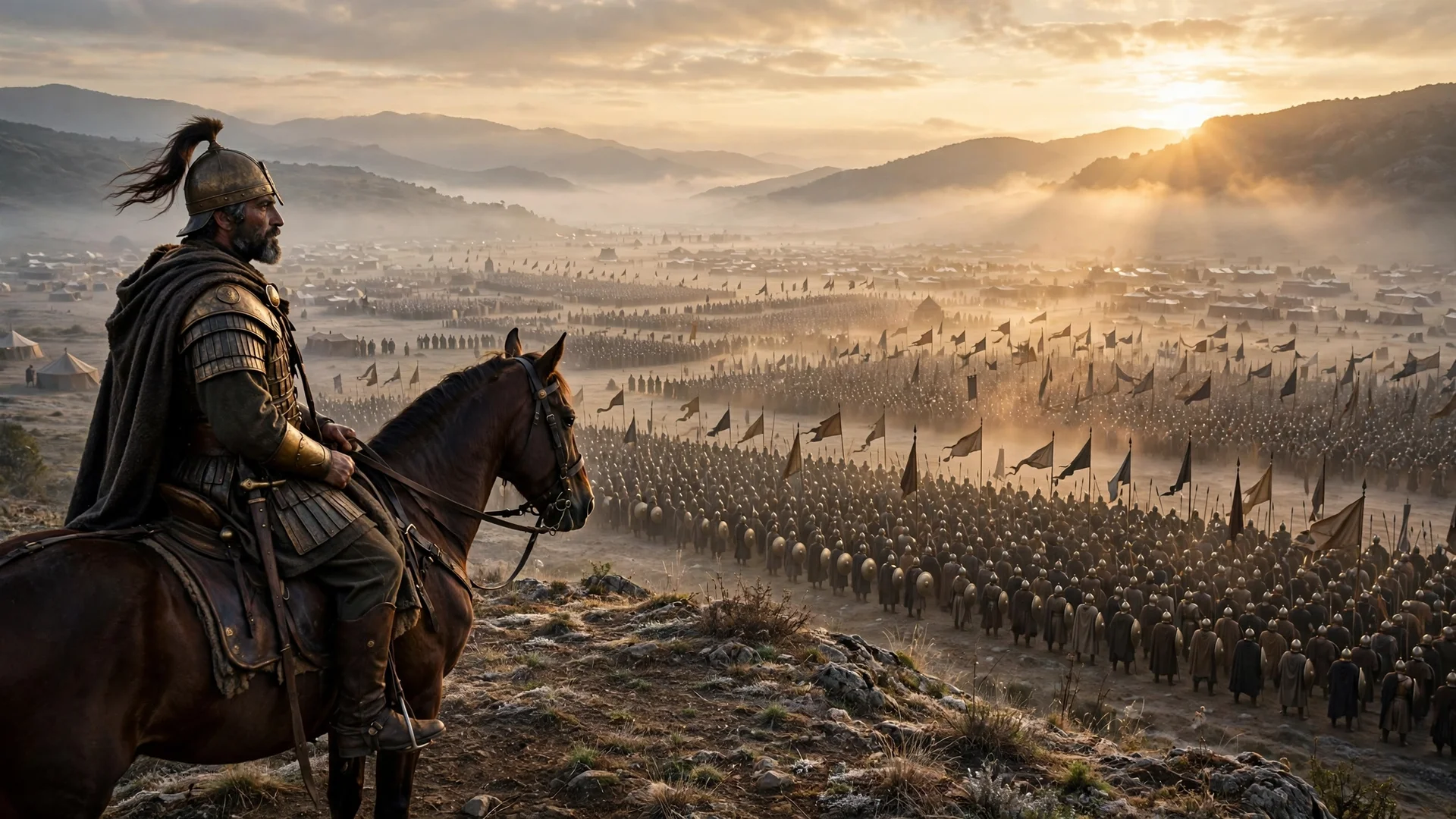
What makes a commander "great"? Not the size of the army — plenty of mediocrities have commanded millions. It's the gap between what they had and what they achieved: winning outnumbered, inventing new ways to fight, and changing what war itself looked like. By that measure, the twenty below stand apart from the other few thousand generals history remembers by name.
A note on fairness: comparing Alexander to Patton is inherently absurd — they fought with different weapons, different maps, different everything. So this isn't a strict 1-to-20 ranking. It's the twenty, grouped by era, each with the case for their greatness laid out. You decide the order.
How Do You Rank Generals?
Four tests. Record: did they win, especially when they shouldn't have? Innovation: did they change how wars are fought? Scale: what did their victories build or save? Longevity: did it work more than once, against more than one enemy? A commander who aces all four is vanishingly rare — which is why this list is only twenty names long.
The Ancient World
1. Alexander the Great (356–323 BC) — Macedon
The benchmark against which all others are measured. Alexander inherited a superb army from his father Philip, then did something no one had done: he took it east and didn't stop. At Issus (333 BC) and Gaugamela (331 BC), his 47,000 men shattered Persian armies the ancient sources number in the hundreds of thousands. He never lost a battle — not one — in twelve years of campaigning from Greece to India. He died at 32, and his empire died with him, but the standard he set never did.
2. Hannibal Barca (247–183 BC) — Carthage
He marched elephants over the Alps. Let that sit for a moment. Hannibal took the war to Rome's doorstep and at Cannae (216 BC) executed the most perfect double envelopment in military history — 50,000 Romans dead in a single day, surrounded by an army half their size. Rome never forgot it; "Hannibal is at the gates" became their phrase for terror. He lost the war (Rome's resources were bottomless), but tactically, Cannae is still taught as the masterpiece.
3. Scipio Africanus (236–183 BC) — Rome
The man who beat Hannibal. Scipio studied his enemy, learned the lessons of Cannae, and at Zama (202 BC) turned Hannibal's own tactics against him — the student surpassing the master on African soil. He ended the Second Punic War and made Rome the Mediterranean's undisputed power. History remembers Hannibal's genius; it should remember that Scipio out-generaled him when it counted.
4. Julius Caesar (100–44 BC) — Rome
Caesar conquered Gaul — modern France and Belgium — in eight years, then won a civil war against the Roman establishment itself. His signature: Alesia (52 BC), where he besieged the Gallic fortress while himself besieged by a relief army — and beat both, building two rings of fortifications facing opposite directions. Audacity raised to engineering. He also wrote the campaign reports himself, which is why we remember him so well.
The Medieval World
5. Khalid ibn al-Walid (592–642) — The Rashidun Caliphate
Known to history as Sayf Allah al-Maslul — the Drawn Sword of God — Khalid ibn al-Walid stands among the finest cavalry commanders who ever lived. A companion of the Prophet Muhammad, he fought over one hundred battles and never lost a single one. His masterpiece was Yarmouk (636 CE), fought over six days in August, where his outnumbered Arab army destroyed the Byzantine field army and opened Syria to the Caliphate. At Walaja he executed a double envelopment against the Persians that historians compare to Cannae. His use of the mobile guard — a hard-riding cavalry reserve thrown in at the decisive moment — was centuries ahead of its time. Dismissed from command by Caliph Umar in 638 (politics, not performance), he died in his bed in Homs in 642 — which, by his own account, was his life's great disappointment.
6. Belisarius (505–565) — Byzantium
Justinian's great gamble: reconquer the Western Roman Empire with almost no troops. Belisarius took North Africa from the Vandals and most of Italy from the Ostrogoths with armies a tenth the size of his enemies', winning through speed, deception, and sheer nerve. He was arguably the most under-resourced genius on this list — imagine Alexander's battles with a tenth of Alexander's men.
7. Genghis Khan (1162–1227) — The Mongol Empire
He started as an orphaned outcast on the steppe and built the largest contiguous land empire in human history — from the Pacific to Eastern Europe. Genghis wasn't just a warrior; he was a military revolutionary: merit-based promotion, decimal organization, integrated intelligence networks, and siege engineers recruited from conquered China. His armies moved faster, knew more, and adapted quicker than anyone they faced. The numbers are staggering and the methods were often brutal — but as a commander, his record is unmatched in scale.
8. Subutai (1175–1248) — The Mongol Empire
Genghis's greatest general — and the least famous name on this list, which is history's oversight, not his. Subutai fought more than 65 pitched battles across twenty years and two continents, from China to Hungary, and never lost a campaign. At Legnica and Mohi in 1241, his armies crushed the knights of Europe in a coordinated campaign fought across hundreds of miles. If Genghis was the architect, Subutai was the instrument — arguably the finest operational commander who ever lived.
9. Saladin (1137/38–1193) — The Ayyubid Sultanate
Salah al-Din Yusuf ibn Ayyub — Saladin to the West — is remembered as much for his character as his generalship, and the character is well documented. At Hattin on July 4, 1187, he destroyed the Crusader field army; that October he retook Jerusalem — and then did something extraordinary: he spared its Christian inhabitants, ransomed the poor himself, and allowed safe passage. Even his enemies, including Richard the Lionheart, honored him. He united Egypt and Syria, ended the Fatimid caliphate, and fought the Third Crusade to a standstill. A commander whose mercy was as famous as his victories.
10. Timur (1336–1405) — The Timurid Empire
The last of the great steppe conquerors. Timur — Tamerlane — built an empire from Delhi to Anatolia, smashing the Ottomans at Ankara in 1402 (capturing Sultan Bayezid himself) and the Golden Horde in Russia. A brilliant tactician and a ruthless one; his pyramids of skulls were deliberate terror. He died marching toward China. History's verdict on Timur the man is dark; on Timur the commander, it's awe.
The Gunpowder Age
11. Napoleon Bonaparte (1769–1821) — France
He reinvented war. The corps system (self-contained mini-armies), the lightning march, artillery massed at the decisive point — Napoleon's methods are still the skeleton of modern operational art. Austerlitz, December 2, 1805: outnumbered, he feigned weakness, let the Austro-Russian army take the bait, then smashed its center. The "Battle of the Three Emperors" remains the most studied battle of the age. Russia in 1812 broke him — overreach, not incompetence — but for fifteen years he was the standard.
12. Arthur Wellesley, Duke of Wellington (1769–1852) — Britain
Born the same year as Napoleon; destined to end him. Wellington never lost a major battle — not in India, not in the six-year Peninsular War in Spain, and not at Waterloo (1815), where with Blücher's Prussians he finished the Napoleonic era. His gift was the defensive battle fought on ground of his choosing, and an almost supernatural calm under fire.
13. Frederick the Great (1712–1786) — Prussia
He made Prussia a great power with an army a third the size of his enemies'. At Leuthen (1757), outnumbered two to one, Frederick used the oblique order — refusing one flank, massing everything on the other — and destroyed the Austrians. Napoleon himself said that if Frederick were alive, France wouldn't have dared challenge Prussia. The master of doing more with less.
14. Horatio Nelson (1758–1805) — Britain
The only admiral on the list, and he belongs here. Nelson broke every rule of naval warfare — dividing his fleet into two columns and driving straight at the enemy line at Trafalgar's predecessor in spirit (October 21, 1805), he annihilated the combined French-Spanish fleet without losing a single British ship. He died in the hour of victory, which is why Britain still puts him on a column. Naval command at its most inspired.
Modern War
15. Ulysses S. Grant (1822–1885) — United States
Grant understood something his predecessors didn't: the Union's advantage was arithmetic, and arithmetic wins wars. At Vicksburg (1863) he ran the boldest campaign of the Civil War; in 1864–65 he pinned Lee in Virginia and never let go. Not flashy — relentless. The general who grasped modern, industrial war first.
16. Robert E. Lee (1807–1870) — Confederate States
The great what-if of American history. Lee repeatedly beat larger Union armies through audacity and perfect reading of terrain — Chancellorsville (1863), where he split his outnumbered force in the face of the enemy, is the textbook example. He fought for a doomed cause with limited means and nearly pulled it off. Tactically, among the finest America ever produced.
17. Erwin Rommel (1891–1944) — Germany
The Desert Fox. Rommel's gift was speed of decision — he read a battlefield faster than anyone and struck before the enemy finished thinking. France 1940 (the 7th Panzer's "ghost division" dash), North Africa 1941–42 against overwhelming Allied material superiority. A tactical genius in the purest sense; his war was maneuver, not ideology, and his forced suicide in 1944 — after the July Plot he barely touched — ended one of the war's most remarkable careers.
18. Georgy Zhukov (1896–1974) — Soviet Union
The indispensable man of the Eastern Front. Moscow 1941, Stalingrad 1942–43, Kursk 1943, Berlin 1945 — Zhukov was at the center of every Soviet victory that mattered, and he never lost a major battle he commanded. He managed million-man operations the way other generals managed divisions. Stalin feared him, which tells you everything.
19. George S. Patton (1885–1945) — United States
America's most audacious field commander. Patton's Third Army tore across France in the summer of 1944 faster than any army in history to that point, then pulled off the war's great logistical miracle: wheeling 90 degrees in mid-winter to relieve Bastogne in December 1944. He believed — correctly, as it happened — that in modern war, speed is armor.
20. Vo Nguyen Giap (1911–2013) — Vietnam
The self-taught general who beat two empires. Giap was a history teacher with no formal military training when he built the Viet Minh army — and at Dien Bien Phu (1954) he did the impossible, dragging artillery through jungle mountains to crush the French. Then he did it again to the Americans. No commander on this list overcame longer material odds, twice.
Twenty names, twenty-three centuries — and every one of them won by seeing what others couldn't.
What They All Shared
Strip away the centuries and the weapons, and the pattern is startlingly consistent. They all moved faster than expected — Alexander's marches, Napoleon's corps, Patton's armor, Subutai's horsemen. They all struck where the enemy was weak rather than where he was strong — Hannibal's envelopment, Khalid's mobile guard, Nelson's breaking of the line. And they all understood their own men — what they could endure, when to push, when to rest.
The deeper truth: none of them won by the book. They won by rewriting it — and then the book was rewritten around them. That's what "greatest" means. Not the biggest army, but the biggest change in what armies could do.
FAQ
Who was the greatest military commander of all time?
Alexander the Great is the most common answer — undefeated in every battle, conqueror of the Persian Empire by age 30. But strong cases exist for Genghis Khan (largest land empire ever), Napoleon (revolutionized warfare), and Khalid ibn al-Walid (undefeated in over 100 battles). Honest historians admit the eras can't fairly be compared.
Was Alexander the Great ever defeated in battle?
No — Alexander never lost a battle in his twelve years of campaigning, from the Granicus (334 BC) to the Hydaspes (326 BC). Gaugamela (331 BC), where his 47,000 men shattered a Persian army several times larger, is considered his masterpiece.
Who was the greatest Muslim military commander?
Khalid ibn al-Walid — known as the 'Drawn Sword of God' — is the most celebrated: undefeated in over 100 battles, including Yarmouk (636 CE) against a far larger Byzantine army. Saladin, who retook Jerusalem in 1187 and was renowned for chivalry even by his Crusader enemies, is the other immortal name.
Was Napoleon a great general or just lucky?
Both, but mostly great. Napoleon revolutionized warfare with the corps system, lightning marches, and concentrated artillery — Austerlitz (1805) is studied in staff colleges to this day. His later disasters (Russia 1812) came from overreach, not lack of skill.
Who was the best general of World War II?
Georgy Zhukov has the strongest record — Moscow, Stalingrad, Kursk, Berlin — and never lost a major battle he commanded. Rommel was the most gifted tactician; Patton the most audacious. Each dominated a different kind of war.
Did Genghis Khan ever lose a battle?
Genghis Khan himself never lost a major campaign, and his general Subutai — who fought over 65 pitched battles across two continents — is arguably the most successful field commander in history. The Mongol military machine they built conquered more territory than any before or since.
Several of these commanders fought the battles we cover in depth — from Issus to Cannae to Waterloo.
Sources
- John Keegan, The Mask of Command (Viking, 1987) — Alexander, Wellington, Grant, Hitler studies in generalship.
- Arrian, Anabasis of Alexander (c. 150 AD) — primary source for Alexander's campaigns.
- Al-Tabari, History of the Prophets and Kings — early Islamic conquests including Yarmouk.
- David Nicolle, Saladin and the Saracens (Osprey, 1986) — Hattin and the Third Crusade.
- Richard J. Evans, The Third Reich at War (Penguin, 2008) — Rommel and the German war effort.