Four years of trench warfare had taught every general on the Western Front the same hard lesson. Attacks failed. They failed slowly, bloodily, and in full view of everyone. Then, on the morning of August 8, 1918, the Allies attacked east of Amiens, in northern France, and broke every rule of that war in a single day. More than 500 tanks rolled out of thick fog at 4:20 in the morning with no warning bombardment at all. By nightfall the Allies had advanced seven miles, taken about 16,000 prisoners, and captured 450 guns. The German commander, Erich Ludendorff, called it the black day of the German Army. He was right. This is the story of the morning the First World War started to end.
The Battle of Amiens was the Allied surprise attack east of Amiens, France, on 8 August 1918, that opened the Hundred Days Offensive. British, French, Canadian and Australian troops, backed by more than 500 tanks and 1,900 aircraft, smashed the German Second Army, advanced seven miles in a day, and broke German morale for good.
Why Amiens? The City Germany Had to Take
Start with the map. Amiens sits on the rail lines that fed the whole British sector in northern France. Every shell, every ration, every reinforcement for the British armies in Flanders passed through its yards. Lose Amiens, and those armies get cut off from their supplies. The Germans knew it. The Allies knew it. And in the spring of 1918, Germany came within ten miles of taking it.
That spring attack was Operation Michael, the first of Ludendorff's great offensives, launched on March 21, 1918. The Germans smashed through the British Fifth Army and drove west until they reached Villers-Bretonneux, about ten miles east of Amiens. There they stopped. British and Australian troops held the village in April, and the German advance ran out of men, shells, and road. But the salient stayed. All summer, a German bulge pointed straight at Amiens like a loaded gun.
By July the tide had turned. The German offensives had spent themselves, the Americans were arriving in numbers, and the Allied supreme commander, Ferdinand Foch, started looking for a place to hit back. He picked Amiens. The German salient there was thinly held, the ground was open rolling country that suited tanks, and a win would do more than take ground. It would protect the rail hub and, if it worked, crack the German army's nerve. Foch gave the job to Douglas Haig's British Expeditionary Force, and Haig gave it to Henry Rawlinson's Fourth Army.
And here is the part most histories skip. The plan wasn't really about Amiens at all. It was about proving that the Allies had learned to fight a new kind of battle, one where infantry, tanks, aircraft, and guns all moved together. A month earlier, at Hamel on July 4, the Australian commander John Monash had run a small rehearsal of exactly that, and finished the job in 93 minutes. Amiens would be Hamel on a grand scale. Or it would be another Somme.
The Secret Nobody Was Allowed to Talk About
The attack depended on one thing above all else: surprise. The Germans had to believe nothing was coming. So the Allies ran a deception that would make a spy novel look lazy. The Canadian Corps, the shock troops of the whole attack, were moved south to Amiens in secret. To sell the lie, two Canadian battalions were sent north to Flanders instead, with orders to make noise, and fake radio traffic chattered away up there as if the whole corps had gone with them.
Tanks moved only at night. Guns were hauled into place under cover of darkness and hidden in woods. Artillery officers were forbidden to register their guns, the usual ranging shots that would have told the Germans exactly where the batteries sat. Even the attack orders carried a blunt instruction to every man involved: keep your mouth shut. Plenty of officers below corps level learned the real plan only hours before zero hour.
The force that assembled in the dark was the biggest the Allies had ever put together for one attack. Rawlinson's Fourth Army held the centre with the Canadian Corps and the Australian Corps side by side, the British III Corps guarding the northern flank, and an American division in reserve. The French First Army under Marie-Eugène Debeney attacked on the right. Behind them sat more than 500 tanks, 342 of them the new Mark V heavy tanks, 72 fast Whippets for the breakout, and the rest supply carriers. Above them, more than 1,900 British and French aircraft. And in front of all of it, over 2,000 guns that had been told, for once, to stay silent until the morning of the attack.
Facing them stood the German Second Army under Georg von der Marwitz. On paper the Germans held a strong position: three lines of trenches, wire, and concrete. In practice the line was thin. HistoryExtra puts the German defenders at about 37,000 men, with around 530 guns and 365 aircraft, against an Allied force of around 100,000 men. The German divisions in the line were worn down from the spring offensives, and their reserves were miles back. Ludendorff's army was tired. Nobody on the Allied side said so out loud yet. They were about to show it.
4:20 a.m.: Fog, Tanks, and No Warning at All
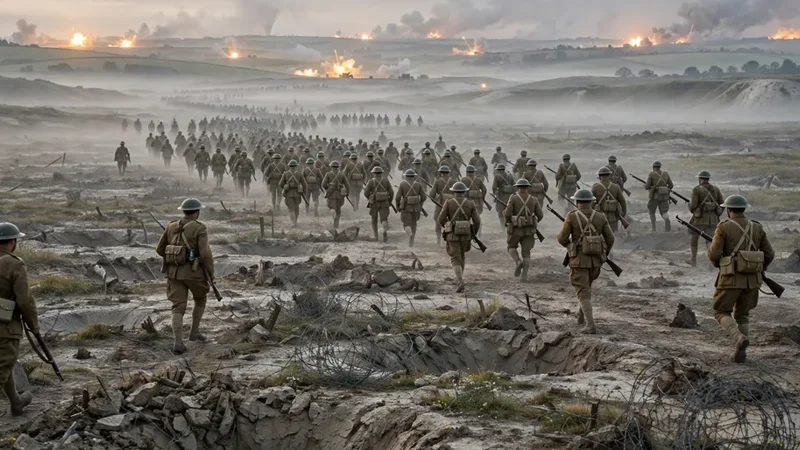
The attack began at 4:20 a.m. on Thursday, August 8, 1918, in dense fog. And that fog was a gift. The tanks rolled forward behind a creeping barrage, the rolling wall of shellfire that advanced just ahead of the infantry, and there was no preliminary bombardment at all. For four years, every big attack on the Western Front had opened with days of shelling that told the defenders exactly where and when to expect the blow. This time the first warning the Germans got was the sound of engines in the mist.
It worked. The first German lines were overrun before 7:30 in the morning. The tanks crushed the wire, the infantry followed through the gaps, and the German forward positions folded. On the right, the French attacked at 5:05 a.m. after a short bombardment of their own, and they too broke through. By mid-afternoon the Canadian and Australian corps in the centre had advanced almost 12 kilometres on a front 22 kilometres wide. In the old language of the Western Front, that wasn't an advance. That was a rout.
The Whippets did what they were built for. The fast little tanks, all 8 miles per hour of them, raced ahead with cavalry and armoured cars to seize bridges and crossroads deep behind the German lines. The German gunners, the men who might have stopped them, were being rounded up in their gun pits before they could fire. By the end of the day the Allies had taken about 16,000 prisoners, 13,000 by the Fourth Army and 3,000 by the French, and 450 guns. The British, Australian, and Canadian infantry of the Fourth Army had lost about 8,800 men. The Germans had lost about 30,000.
Let that sink in. In a war where a hundred yards could cost a thousand lives, the Allies had just taken seven miles in a day. Men who had spent four years measuring progress in trenches and shell holes were suddenly walking through open country. One Australian wrote home that it felt like the war had changed overnight. He wasn't wrong.
Seven Miles in a Day: August 8, Hour by Hour
4:20 a.m.: the fog attack. In dense fog, the Fourth Army's tanks roll forward behind a creeping barrage with no preliminary bombardment. The Germans hear engines in the mist before they see a single Allied soldier.
5:05 a.m.: the French join in. Debeney's French First Army attacks on the southern flank after a short bombardment, and breaks through just like the British. The whole German line is under pressure at once.
7:30 a.m.: the first lines fall. The German forward positions are overrun. Tanks crush the wire, infantry pour through the gaps, and whole German units start surrendering where they stand.
Mid-afternoon: the centre breaks open. The Canadian and Australian corps have advanced almost 12 kilometres on a 22-kilometre front. Whippet tanks, cavalry, and armoured cars race ahead to seize bridges and crossroads on the Amiens Outer Defence Line.
Nightfall: the count. The Allies have advanced 11 kilometres, seven miles, in a single day. About 16,000 prisoners, 450 guns, and German losses of about 30,000. The Fourth Army's infantry has lost about 8,800 men. Nobody on the Western Front has seen a day like it since 1914.
The Black Day: What Ludendorff Said Afterward
The German high command understood what had happened faster than the Allies did. Erich Ludendorff, the man who effectively ran the German war effort alongside Paul von Hindenburg, wrote in his memoirs that "August 8th was the black day of the German army in the history of the war." The German official history said much the same thing in plainer language, calling it the greatest defeat the German Army had suffered since the beginning of the war.
Ludendorff didn't lose sleep over the ground. He lost it over the way his men gave it up. Upwards of 12,000 German soldiers had surrendered, many of them without a real fight, and whole gun batteries had fallen into Allied hands intact. His own words again: "August 8th put the decline of our fighting power beyond all doubt." He offered his resignation to the Kaiser. The Kaiser refused it, but agreed with Ludendorff's other conclusion: the war had to be brought to an end.
Honestly, this is the part of Amiens that matters most, and it is the part the casualty tables never show. Armies don't collapse because they run out of men. They collapse because the men stop believing the war can be won. On August 8, 1918, thousands of German soldiers stopped believing. Ludendorff saw it happen in a single day. That's why he called it a black day, and not just a bad one.
August 9 to 11: When the Attack Ran Out of Road
The attack went on for three more days, but the magic of the first morning never came back. On August 9 and 10 the Allies kept pushing, and kept gaining ground, but the gains got smaller and costlier every time. German reserves arrived, the resistance stiffened, and the tanks started to die. Not to enemy fire, mostly. To breakdowns. The Mark Vs were heavy, slow, and brutal on their own engines, and by August 11 only six of the tanks that had attacked on the 8th were still fit to fight.
The infantry had outrun its own guns, too. The artillery that had fired the creeping barrage on the morning of the 8th was still stuck miles back, and without it the attack lost its edge. Haig and Foch called a halt on August 11. The battle was over. In four days the Allies had taken ground that four years of fighting had never won.
The final bill for the battle tells its own story. The British Empire lost 22,202 men killed, wounded, and missing. The French lost 24,232. The Germans lost as many as 75,000, and nearly 30,000 of those were prisoners. Read those numbers again. For the first time in the war, the side doing the attacking lost fewer men than the side defending. That had almost never happened on the Western Front.
The Casualties, Honestly Counted
A word of caution before you quote any of these numbers. The sources disagree, and the disagreements are honest ones. German losses on August 8 alone are given as 27,000 by some histories and 30,000 by others. The prisoner count for the day runs from 12,000 to 16,000 depending on whether you count the French captures with the British ones. The total German loss for the whole battle is put as high as 75,000, with 29,873 of them prisoners. The figures in this article follow the standard synthesis: Wikipedia's battle summary, HistoryExtra, and WarHistory.org. If you find a source with a different total, it is probably counting a different day, or a different thing.
One figure nobody argues about is the guns. About 450 German guns were captured on the first day alone. Guns are hard to lose track of. Men, in the fog and the confusion of August 8, were not.
Why Amiens Actually Mattered
So why does Amiens matter? Start with what came next. The battle was the opening blow of the Hundred Days Offensive, the string of Allied attacks that ran from August 8 to the Armistice on November 11, 1918. Amiens was followed by the Second Battle of the Somme, the breaking of the Hindenburg Line in September, and the collapse of the German armies in October. Ninety-five days after the fog lifted at Amiens, the guns stopped. No other single battle of 1918 can claim that kind of follow-through.
Second, Amiens changed how wars were fought. The combination of surprise, tanks, aircraft, and artillery moving to a single plan became the model for the rest of the century. Monash's rehearsal at Hamel and Rawlinson's attack at Amiens showed that the tank wasn't a curiosity. It was the weapon that broke the trench deadlock. Every army in the world spent the next twenty years learning that lesson, and the next war was fought with it.
Third, and least visible, Amiens broke the German army's belief in itself. The German soldiers who surrendered in droves on August 8 were not cowards. They were men who had been told for four years that the next offensive would win the war, and who had just watched their spring offensives fail. Ludendorff's black day was black because it was the day the German army stopped believing its own promises. Armies can survive losing ground. They can't survive losing faith.
And here is the honest downside. Amiens didn't end the war by itself, and it's a mistake to read it that way. Three more months of hard fighting followed, and tens of thousands more men died before the Armistice. The tanks that looked so unstoppable on August 8 spent most of August 9 to 11 broken down by the roadside. And in popular memory, Amiens still sits in the shadow of the Somme and Verdun, the great slaughters that came before it. That's a shame. The Somme showed what the old way of war cost. Amiens showed what the new way could do. If you want to understand how the First World War actually ended, start here, not at the Somme. Our Battle of the Somme summary tells the other half of that story, and our World War 1 tank warfare guide follows the machines that made Amiens possible.
A Note on the Numbers
The numbers in this article come from the standard sources, and where they disagree, this article says so. The date is August 8 to 11, 1918, for the main fighting, though some histories run the battle to August 12. The tank count is usually given as 532, though some counts run higher because they include supply tanks and armoured cars. The German strength in the line is put at about 37,000 men by HistoryExtra, while other sources count divisions instead. And the famous six battle-ready tanks on August 11 is the figure from the Tank Corps' own reckoning. None of this changes the story. The fog, the surprise, the advance, and the black day are all solid.
3 Lessons from Amiens
Amiens is a battle, but it is also a manual for winning when everyone expects you to lose. Three lessons worth keeping:
1. Surprise is worth more than shells. For four years, attacks opened with days of bombardment that warned the enemy and churned the ground into mud. At Amiens the Allies skipped the warning, hid the buildup, and let the fog do the rest. The result was the biggest single-day advance of the war. If your plan depends on the other side not knowing, guard the secret like it is the plan. Because it is.
2. Make every arm fight the same battle. Infantry, tanks, guns, and aircraft all attacked together at Amiens, on one timetable, toward one objective. At Hamel, Monash had proved it worked on a small scale. At Amiens, Rawlinson proved it worked at army scale. The lesson isn't about tanks. It's about coordination. A mediocre plan that every arm follows beats a brilliant plan that only half the army knows about.
3. Stop while you are winning. Haig called the attack off on August 11, with the tanks broken and the guns miles behind. Plenty of generals in that war would have kept pushing and turned a victory into a bloodbath. Knowing when the conditions that made you win have gone is a skill, and it is rarer than courage. If you ever find yourself winning, ask what is about to run out. Then stop before it does.
Sources
- Wikipedia, Battle of Amiens (1918)
- HistoryExtra, Remembering the battle of Amiens
- WarHistory.org, Amiens 1918
- Roads to the Great War, 100 Years Ago: The Battle of Amiens Opens