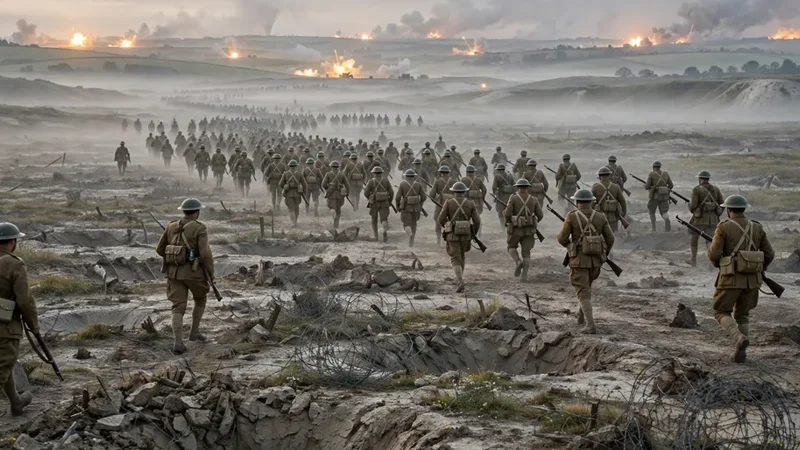
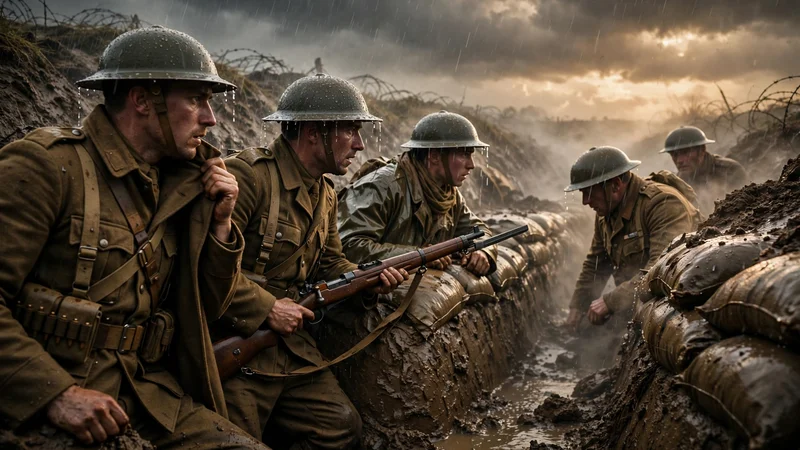
Picture a steel box on caterpillar tracks, 28 tons of it, crawling across a battlefield at the speed of a brisk walk while bullets hammer off its sides. Now picture that in 1916, when no soldier alive had ever seen anything like it. That was the first tank. It broke down constantly. It cooked its own crew alive in summer. And it scared the hell out of the men on the other side of no man's land.
World War 1 tank warfare was the use of armored, tracked fighting vehicles to break the trench deadlock on the Western Front between 1916 and 1918. Tanks crossed barbed wire, crushed trenches, and gave infantry moving cover. They worked best in large numbers, with artillery and infantry support, and failed badly when used alone.
If you have ever wondered why modern armies still build their whole doctrine around tanks, this is where it started. Not with a perfect weapon. With a clumsy, leaking, half-blind steel box that worked just well enough to change everything.
So what was a World War 1 tank, actually?
Forget the sleek machines you see in movies. A British Mark I from 1916 looked like a giant metal lozenge on tracks, with the tracks running all the way around its body. It weighed about 28 tons. It carried a crew of eight men crammed inside a steel oven with an engine. Its top speed was around 4 miles per hour, and that was on a good road. Cross-country, it went slower. Much slower.
There were two versions. The "male" tank carried two 6-pounder guns sticking out of its sides, in armored boxes called sponsons. The "female" version carried machine guns only. The idea was simple. Males would smash strongpoints. Females would hose down infantry. In practice, both versions broke down, threw tracks, got stuck in shell holes, and filled with exhaust fumes so thick the crew sometimes passed out at their posts.
Honestly, the first tanks were awful machines. I mean that as a compliment. They were awful and they still mattered, because nothing else on the battlefield could do what they did: roll straight over barbed wire, drop into a trench, climb out the other side, and keep going while rifle fire bounced off.
Why did anyone build a tank in the first place?
By 1915, the Western Front had frozen solid. Two armies sat in trenches from the Belgian coast to Switzerland. Between them lay barbed wire, machine guns, and artillery that could shred any attack in minutes. Generals kept ordering men forward anyway. The men died. Nothing moved.
The problem was mechanical, so the answer had to be mechanical. A British officer named Ernest Swinton had been thinking about armored tractors since before the war. In February 1915, Winston Churchill, then First Lord of the Admiralty, backed a secret group called the Landships Committee. The navy connection sounds odd until you realize the navy had the engineers, the steel, and the habit of building big secret machines.
The cover story is my favorite detail of the whole war. Workers were told they were building mobile water carriers for the army in Mesopotamia. The word "tank" stuck. And the first prototype, nicknamed Little Willie, rolled out in December 1915. It looked like a shed on tracks. But it worked. By early 1916 a bigger prototype, called Mother, proved the lozenge shape could cross a trench. The army ordered 100 of them.
And here is the part most histories rush past. Nobody really knew what tanks were for yet. Were they mobile artillery? Armored taxis for infantry? A terror weapon? The men building them were inventing the doctrine as they went, in the middle of the bloodiest war in history. That guesswork explains almost everything that went wrong next.
The first tanks were awful. They went anyway.
September 15, 1916. Flers-Courcelette, during the Battle of the Somme. British records put the debut at 49 tanks sent forward with the infantry attack. Breakdowns cut that number down before the attack even started, and only a handful actually broke into the German trenches.
So was it a failure? That depends on what you count. As a weapon, the debut was a mess. As a demonstration, it was electric. German soldiers who had never seen armor on tracks watched steel monsters crawl through their wire. Some ran. Some surrendered. A few German reports from that morning read like ghost stories. The British high command, which had wanted to keep tanks secret until hundreds were ready, had spent the surprise on a handful of machines. Douglas Haig's staff argued about that decision for years afterward.
But look at what the Somme debut proved. Tanks could cross ground that stopped everything else. Infantry following a tank had cover that actually moved with them. And the tank's real enemy, it turned out, was not German guns. It was itself. Engines overheated. Tracks snapped. Crews choked on fumes and carbon monoxide. At Passchendaele in 1917, tanks drowned in the Flanders mud before they ever reached the German line. Mud did what machine guns could not.
You have probably heard the Somme called Britain's bloodiest day. Our Battle of the Somme summary covers that ground in full. The tank debut was a footnote to that battle. It became the main story of the next two years.
Cambrai: the morning 476 tanks changed everything
November 20, 1917. Cambrai, in northern France. This time the British did it properly. The Tank Museum in Bovington puts the Cambrai force at 476 tanks, the first time armor was used in mass. And the plan broke every rule of the war so far.
There was no days-long artillery bombardment to warn the Germans. The tanks went in at dawn, behind a short hurricane bombardment, with infantry trained to follow them closely. The man in charge of the Tank Corps, Brigadier Hugh Elles, led from a tank at the front, sending the signal "tanks leading" as the attack rolled forward. By midday, British tanks had punched through the Hindenburg Line, the strongest defensive system on the Western Front, and advanced up to 5 miles in places. Roughly 8,000 German prisoners were taken on the first day.
Church bells rang in Britain. Newspapers called it a miracle. And then, ten days later, the Germans counterattacked and took most of the ground back. The British had no reserves to hold what the tanks had won. The infantry was exhausted. The tanks that survived were worn out. Cambrai ended as a tactical draw wearing a victory's clothes.
Here is my honest take, and I will defend it. Cambrai matters more than the Somme debut, and more than Amiens, for one reason. It proved the method. Massed tanks, used by surprise, with infantry trained to work with them, could break any defensive line on the Western Front. The failure to hold the ground was a failure of reserves and planning, not of the tank. Every army in the world read the Cambrai reports and started building tanks. That is the real verdict of November 1917.
What about the French and the Germans?
Britain was not alone in the tank business, though it had a head start. France built the Schneider CA1, which went into battle in April 1917 at the Chemin des Dames and took heavy losses from German artillery. The Saint-Chamond, France's other early tank, was worse, too long, too nose-heavy, and prone to ditching in trenches.
Then France built the tank that actually mattered. The Renault FT arrived in late 1917, and it was a different animal entirely. Small, light, with a crew of just two, and the first tank in history with a fully rotating turret on top. The driver sat in front. The commander stood in the turret and fought the gun. That layout, driver low, commander in a turret, is the layout of almost every tank built since. France built more than 3,000 of them. If the British Mark series was the tank's childhood, the Renault FT was the first tank that looked grown up.
Germany, meanwhile, barely built tanks at all. The German high command never believed in them the way Britain and France did. Germany produced only 20 of its A7V heavy tank, a boxy machine that looked like a moving fortress and handled like one. Most German "tank" units in 1918 actually used captured British Mark IVs, repainted with German crosses. Think about that. The army that invented the tank's deadliest counter in the next war spent this war driving its enemy's machines.
The first time tanks fought tanks
April 24, 1918. Villers-Bretonneux, in Picardy. Three German A7Vs advanced with infantry against the British line. Three British Mark IVs moved to meet them. Two were female machine-gun tanks. One was a male with 6-pounder guns.
The female tanks, outgunned, pulled back after taking hits. The male Mark IV, commanded by Lieutenant Frank Mitchell, stood and fought. Its 6-pounders hammered the lead A7V until the German crew abandoned it. The other two A7Vs withdrew. It was the first tank against tank battle in history, and it lasted minutes.
Why does a tiny skirmish deserve a section of its own? Because it settled a question nobody had been able to answer. What happens when armor meets armor? The answer was ordinary and brutal. The tank with the bigger gun and the cooler crew won. Tank warfare stopped being a trick played on infantry. It became a duel.
Hamel and Amiens: tanks finally done right
July 4, 1918. Hamel, a village on the Somme. The Australian general John Monash planned an attack so precise it ran like a timetable. Tanks, infantry, artillery, and aircraft were coordinated down to the minute. The whole position fell in 93 minutes. Monash had proved that tanks worked best not as a solo act but as one instrument in a combined orchestra.
Then came Amiens. August 8, 1918. More than 500 tanks went forward with infantry, artillery, and aircraft in the biggest combined-arms attack of the war so far. The attack advanced about 7 miles on the first day and took thousands of German prisoners. German general Erich Ludendorff later called August 8 the black day of the German Army. He was not being poetic. German morale cracked that day in a way it never recovered from.
And here is the thing most tank histories skip. The tanks at Amiens broke down in droves, just like they always did. By the second day, many were dead on the battlefield, out of fuel or thrown tracks. The attack slowed. But the damage was done. The German Army had been beaten in open ground, in a battle of movement, for the first time in years. The tank had finally done the job it was invented for, and it did it by working with everyone else.
If you want to see where this story goes next, our largest tank battle in history guide jumps forward to Kursk in 1943, when thousands of tanks fought the battle the pioneers of 1916 could only imagine. The machines changed. The lesson from Amiens did not.
So did tanks win the war?
No. And yes. Both answers are true, and anyone selling you just one of them is selling you something.
No, because tanks alone never won a battle in World War 1. They broke down too often. They were too slow to exploit a breakthrough. They could not hold ground by themselves. At Cambrai they won the ground and lost it again because the rest of the army could not keep up. At Passchendaele the mud beat them before the enemy did. A weapon that stops working after a few miles cannot win a war on its own.
But yes, because tanks broke the deadlock that nothing else could break. Before tanks, the Western Front rewarded defense absolutely. After tanks, generals could imagine attack again. Amiens in August 1918 began the Hundred Days Offensive that ended the war in November. Tanks were part of every one of those offensives, not as a miracle weapon but as the tool that let infantry move forward under fire.
That is the honest downside of the tank story, and the honest upside. The first tanks were unreliable, slow, and murderously uncomfortable. They were also the first weapon that let soldiers cross a battlefield designed to kill them. Both facts matter. Forget either one and you get the story wrong.
What the tank left behind
By November 1918, every major army was building tanks or planning to. The Renault FT's turret became the standard. The combined-arms method from Hamel and Amiens became doctrine. And the tank's weaknesses, speed, reliability, and supply, became the engineering problems of the next twenty years.
The men who drove the first tanks knew none of this. They knew heat, fumes, noise, and the strange feeling of watching bullets bounce off the steel around them. Some of them wrote home about it. Most of them just got on with it.
So next time you see a tank in a museum, skip the gun for a minute. Look at the driver's hatch. Imagine climbing in there in 1916, with eight men, an engine, and no idea whether the machine would get you across no man's land or die halfway. Then remember that it worked. Not perfectly. Not cleanly. But well enough that war was never the same again. Start with Cambrai if you only read one more battle. That morning is where the modern battlefield begins.
Sources
- Britannica, Tank (military vehicle)
- The Tank Museum, Bovington, tankmuseum.org
- Wikipedia, Battle of Cambrai (1917)
- Wikipedia, Battle of Amiens (1918)