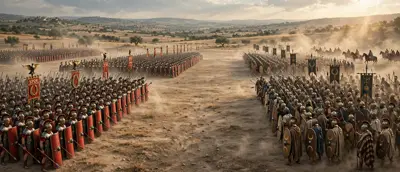
The Battle of Kadesh is the most important battle nobody actually won. Picture this: around 1274 BC, on a river plain in what is now Syria, the pharaoh of Egypt charged into the largest chariot fight the world had ever seen, lost control of his army in about an hour, and then ordered his scribes to carve the whole thing up as his greatest personal triumph. That is not an exaggeration. That is what the temple walls say, and historians have spent a century reading between the lines of them.
You need to grasp one thing before the story makes sense. Nobody in the ancient world had ever written down a battle like this before. Kadesh is the first battle in history with an actual narrative: named commanders, a plot twist, dialogue, even a prayer. Everything we know about ancient warfare before this comes from fragments and king lists. From Kadesh onward, the battle story as a form begins here. And you have probably wondered how we know anything at all about Bronze Age war. This battle is the answer.
Why Was Syria Worth Fighting Over?
The Battle of Kadesh was fought around 1274 BC near the Orontes River in modern Syria between Pharaoh Ramesses II's Egyptian army and the Hittite Empire under King Muwatalli II. The first battle in history recorded in detailed narrative sources, it ended in a draw that led, sixteen years later, to the world's oldest surviving written peace treaty.
Here is the thing. Ramesses II did not march north for glory alone. He went because Syria had slipped out of Egyptian control, and a pharaoh in his fifth year on the throne needed to prove the empire still reached the Orontes River. Muwatalli II ruled the Hittite Empire from his capital at Hattusa in Anatolia, and northern Syria was his front yard. The prize was simple and boring, which is why it is believable: the trade routes. Caravans moved copper, tin, and luxury goods between Mesopotamia and the Mediterranean, and whoever held Syria taxed them. Follow the taxes. You will usually find the war.
Ramesses was about twenty-five when he marched. The Egyptian inscriptions describe his army in unusual detail: four divisions, each named for a god. Amun, Ra, Ptah, and Set. Roughly 5,000 men in each division, so about 20,000 total, with around 2,000 chariots. Honestly, Ramesses marched north with the confidence of a man who thought history was already on his side. To be fair, he had earned some of it. He had been leading campaigns in Canaan since his early twenties, and the Hittites had never yet fought him face to face. Both sides were guessing about the other. That guessing almost killed him.
Kadesh was the hinge of the whole campaign. The fortified city sat on the Orontes in Amurru, a small buffer kingdom that both empires claimed. Take Kadesh and the road to Damascus opens. Hold it and Egypt stays south of the river. Ramesses planned to take it. Muwatalli planned to stop him. Neither man was bluffing, and both of them brought everything they had.
How Two Captured Spies Nearly Killed a Pharaoh
The battle turned on a lie, and the lie came in chains. As the Egyptian army approached Kadesh, Ramesses's scouts captured two Shasu, nomadic tribesmen from the desert fringe. Under questioning, the two men told a convincing story: the Hittite king was far away at Aleppo, more than 200 kilometers to the north, too frightened to face the pharaoh in the field. Ramesses believed them. That single decision shaped the whole day.
Acting on the false report, Ramesses crossed the Orontes River with only his lead division, Amun, and made camp northwest of Kadesh. His other three divisions were still strung out on the road behind him, some 15 to 20 kilometers back. He had split his army in front of the enemy and he did not know it. If you have ever wondered what military disaster looks like from the inside, this is it: a young king sitting in his tent, completely unaware that Muwatalli and his entire army were hiding on the far side of the river, watching. What would you have done with an army split across twenty kilometers and the enemy suddenly everywhere?
The truth surfaced when the spies were beaten a second time and confessed. The Hittite army was not at Aleppo. It was right there, concealed behind Kadesh. What happened next is the part the Egyptian scribes wanted you to forget. Ramesses scrambled, sent urgent orders to bring up the Ptah division, and then the blow fell: the Hittite chariots forded the Orontes and smashed straight into the Egyptian camp from the rear.
Here is the detail that shows how well Muwatalli had planned it. The Egyptian inscriptions credit the Hittites with 2,500 chariots, supported by infantry contingents from at least nineteen allied states. Egyptian sources claim 37,000 Hittite foot soldiers. Modern historians think the real total was lower, maybe 15,000 to 20,000 men altogether. But the chariots are the point. The two sides together put roughly 4,500 to 5,000 chariots on the field that day, which likely makes Kadesh the largest chariot battle ever fought. And Muwatalli had aimed every one of them at a camp that was not ready.
The Afternoon a Pharaoh Fought for His Life
What happened in the camp is where the propaganda starts, so let us separate the two versions. The Poem of Pentaur, the Egyptian account, says Ramesses stood alone. His division broke around him. He prayed to the god Amun, charged the Hittite chariots six times by himself, and the god answered his prayer and gave him strength. It is magnificent writing. It is also the official story, carved on temple walls across Egypt, and official stories have a job to do.
The practical truth is less glorious but more impressive in a way. Ramesses rallied what was left around him, his personal guard, the household troops, a few officers, and fought his way out of the encircled camp in his chariot. He did not win the battle single-handed. What he did was refuse to collapse, and that held the line long enough for the army to save itself. And here is where fortune finally showed up. The Ra division marched into the fight. Then, late in the day, the Ptah division arrived and struck the Hittite rear. A force of Ne'arin troops, allies from coastal Canaan, hit the Hittites from another direction. Muwatalli, who had kept his infantry in reserve and never committed it, pulled back behind the walls of Kadesh.
Most people get this wrong, and it is worth saying plainly. They read the Poem of Pentaur like a news report. It is not. It is the first campaign memoir of a king who almost died, and it reads exactly like one. The parts about the prayer to Amun? Maybe he prayed. Kings pray when chariots are coming. But the lone-hero charge is the story Ramesses needed his people to believe, and he made sure every temple in Egypt told it. That does not make him a coward. It makes him a survivor with a press office.
The next morning Ramesses attacked Kadesh itself. The city did not fall. He could not take it, so he withdrew south with his army, claiming victory the whole way home. Nobody knows the casualty figures. The Egyptian inscriptions do not give honest numbers, and the Hittite records are nearly silent about the battle. So anyone who quotes you a death toll for Kadesh is guessing. Remember that.
So Who Actually Won at Kadesh?
Let us answer it straight. Nobody did. Ramesses came home, carved his triumph across half of Egypt, and told everyone he had won. But Egypt did not take Kadesh, did not retake Syria, and Amurru stayed in the Hittite orbit. If you judge the battle by the map, which is the only honest way to judge a battle, the Hittites achieved their goal and Ramesses did not. His "victory" was a story for the folks back home. A very good story. Carved in stone.
And yeah, that might sound harsh. But here is the honest downside of this whole famous battle: the fighting changed nothing. Two empires bled on the Orontes plain and went home to the same borders they had started with. If you are looking for the real significance of Kadesh, do not look at the battle. Look at what came sixteen years later. That is where the story actually pays off. Our Battle of Gaugamela summary shows what a genuinely decisive ancient battle looks like, and the contrast with Kadesh is the whole point.
What the Temple Walls Don't Tell You
Everything we know about Kadesh comes, in the end, from one side of the war. The Egyptian sources are astonishingly rich: the Poem of Pentaur, a second account called the Bulletin, and huge carved reliefs at Abu Simbel, Karnak, Luxor, Abydos, and the Ramesseum. The American scholar James Henry Breasted translated them in 1906 in his Ancient Records of Egypt, and the British Egyptologist Kenneth Kitchen spent decades sorting the Ramesside inscriptions. Modern historians like Trevor Bryce, in The Kingdom of the Hittites (1998), have rebuilt the Hittite side from the clay-tablet archives at Hattusa. But here is the catch: the Hittite archives barely mention the battle. Muwatalli died a few years after Kadesh, his son Urhi-Teshub was overthrown by his own uncle Hattusili III, and nobody in Hattusa had any reason to carve a triumph about it.
So the Egyptian version stands almost alone, and it is royal propaganda by design. The troop figures are rounded up. The enemy's strength is exaggerated. Ramesses's personal heroism is maximized. That does not mean it is useless. Court scribes still had to describe real armies, real divisions, real places, or the story would not have worked on people who had been there. The trick is reading it like a lawyer reads a witness with an interest in the case. Believe the geography. Doubt the adjectives.
The Peace Treaty That Outlived the Battle
Sixteen years after the battle, in about 1259 BC, the twenty-first year of Ramesses II, the two empires signed a peace treaty. Muwatalli was dead. The new Hittite king was his brother Hattusili III, who had seized the throne from his nephew, and Hattusili needed peace the way a man with rivals needs walls. Assyria was rising in the east and threatening both empires. Fighting each other had stopped making sense.
The treaty is a remarkable document. A defensive alliance: if either king was attacked, the other would send help. A pledge against harboring each other's fugitives. Mutual support for each king's chosen successor. It was written in Akkadian, the diplomatic language of the age, on clay tablets found in the Hittite capital's archives, and Ramesses had a hieroglyphic version carved on temple walls in Egypt. Egyptologists call it the earliest surviving written peace treaty in history. A copy of it is displayed at the United Nations headquarters in New York. Think about that for a second. How often does a battle's most important product turn out to be paperwork? A treaty signed 3,285 years ago is still the model people reach for when they want to talk about peace between nations. The battle that produced it is the reason we are still talking about it.
3 Lessons from Kadesh
Kadesh is a battle, but it is also a case study in how wars actually work. Three lessons worth keeping:
1. Verify your intelligence. Then verify it again. Ramesses lost the first hour of the battle because two prisoners told him what he wanted to hear, and he never checked. The Hittite army was never at Aleppo. It was across the river, waiting. Every disaster in this story flows from that one unexamined claim. If a fact is load-bearing, test it. That is as true in a boardroom as it was on the Orontes.
2. Survival can be the victory. Ramesses did not win at Kadesh. But he did not die either, and his army did not disintegrate, and sixteen years later his name was on a treaty that secured Egypt's northern border for the rest of his sixty-six-year reign. History remembers the men who hold things together when the plan falls apart. That lesson is worth more than any triumph carved in stone.
3. Tell your own story, or someone else will. The Poem of Pentaur is spin. But without it, Kadesh would be a footnote in a Hittite archive, and Ramesses would be a king who marched north and came home empty-handed. Instead he is Ramesses the Great, and his version is carved across Egypt. That is propaganda working exactly as intended. The uncomfortable truth? It worked because there was a real core of courage inside the exaggeration. Spin with nothing underneath eventually rots. Kadesh still stands.
Sources
- James Henry Breasted, Ancient Records of Egypt, Vol. III (1906): the classic English translation of the Poem of Pentaur and the Bulletin
- Trevor Bryce, The Kingdom of the Hittites (Oxford University Press, 1998): the Hittite side, rebuilt from the Hattusa archives
- Kenneth A. Kitchen, Ramesside Inscriptions: the standard edition of Ramesses II's temple texts
- Wikipedia, Battle of Kadesh
- Metropolitan Museum of Art, Heilbrunn Timeline of Art History: the Kadesh reliefs and their context