This Battle of Salamis summary comes down to a lie told in a rowboat. In late September 480 BC, a slave crossed the straits off Athens in the dark, handed the Persian king a fake message, and set up the greatest naval ambush of the ancient world. By noon the next day, Persia's huge fleet was wreckage. Xerxes watched the whole thing from a throne on the hillside. If you remember one thing about Salamis, remember this: the Greeks didn't win because they had more ships. They won because they chose where the battle happened, and they made the enemy agree to it.
Why Was Athens Empty When the Persians Arrived?
Picture this. Late September, 480 BC. A Persian army walks into Athens, the greatest city in Greece, and finds almost nobody home. The houses stand empty. The streets are silent. Just a few priests barricaded on the Acropolis and a handful of stragglers who refused to leave. You can almost hear the soldiers' confusion. Where did thirty thousand people go?
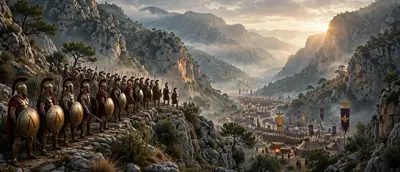
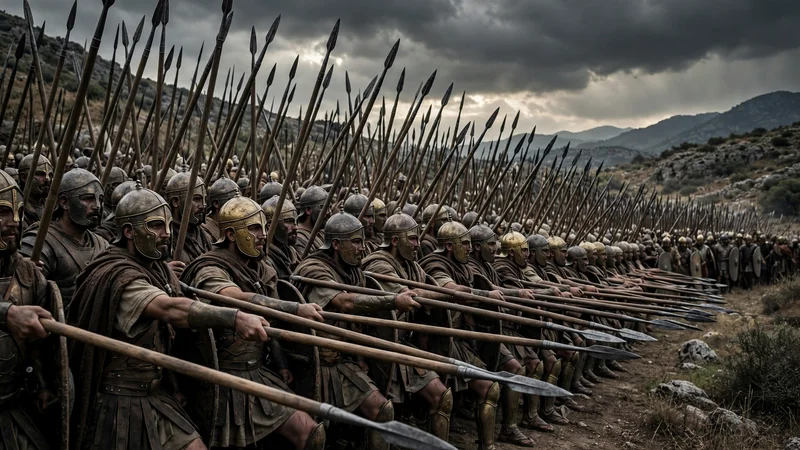
Thermopylae had fallen in August. You probably know that story, 300 Spartans and their allies holding a mountain pass for three days against Xerxes' invasion. Our Battle of Thermopylae summary covers it in full. When the pass fell, the road to Athens stood wide open, and no army remained between the Persians and the city.
So Athens did something that took more courage than fighting: it gave up the city. Every man, woman, and child boarded ships and ferries and crossed to the island of Salamis, to Troezen, to Aegina. The whole population evacuated. The Persians took a ghost town, sacked the Acropolis, and burned the temples. It looked like the end of Greece.
And honestly, if you're Xerxes, king of the largest empire on earth, standing on the shore looking at 370-odd Greek ships crammed into the Salamis straits, you'd think the war was already over. That's exactly what he thought. And that's exactly why he lost.
The 'Wooden Wall' Bet That Saved Greece
Before the evacuation, the Athenians sent to the oracle at Delphi, the way Greeks consulted Delphi for everything from marriage advice to war plans. The priestess gave them a terrifying answer: Athens would burn, she said, and only a "wooden wall" would save them. The old men argued the wooden wall meant the palisade around the Acropolis. One man disagreed. Themistocles.
Themistocles said the wooden wall was ships. Triremes. Athens had spent the previous years building a fleet, paid for with silver from the mines at Laurium, and Themistocles had pushed the policy through against real opposition. Now he needed an entire population to stake their lives on his reading of a riddle.
Most retellings skip this. This was a political gamble, not a military one. Themistocles wasn't a king. He was a politician. He had to talk an entire city into abandoning their homes and trusting their survival to 170 oars per ship and one good plan. Nobody does that without believing, really believing, that the plan works. He believed.
So when you hear that Salamis saved Greece, remember who set the table. The battle was won in the straits. The war was won, months earlier, in an Athenian assembly, by a man who read "wooden wall" and saw a fleet. He didn't improvise Salamis. He built it, plank by plank, before the Persians ever landed.
A Slave, a Message, and the Night That Trapped a Fleet
After Thermopylae, the combined Greek fleet pulled back to Salamis. And here is where the politics nearly sank everything. The Spartans and Corinthians wanted to sail south, defend the Peloponnese, build a wall across the isthmus at Corinth, and abandon central Greece. Athens would be left to burn alone. You can see their logic. You can also see why Themistocles lost his mind.
He argued for days that the straits at Salamis were the one place where Greek skill could beat Persian numbers. The council voted him down. So he did what frustrated men with great plans have done throughout history: he changed the facts and made the council catch up.
Themistocles sent his trusted slave Sicinnus across to the Persians in a small boat, with a message for Xerxes himself. The message said Themistocles was secretly on Persia's side. The Greeks were quarreling. They planned to slip away in the night. If the Persians blocked the exits now, the Greek fleet was trapped and the war would end tomorrow.
It was a lie from start to finish. And Xerxes swallowed it whole.
That night the Persians moved exactly as the message demanded. An Egyptian squadron sailed around the island to block the western channel. Phoenician ships took station along the Attic coast on the right wing. Ionian Greeks, fighting for Persia, held the left near Salamis town. When dawn came, the Greek fleet found every exit guarded by Persian warships.
The trap had snapped shut. Only it had snapped shut on the wrong animal. Because the Greeks couldn't leave now, they had to fight in the straits. Which is precisely where Themistocles wanted them all along. If you ever doubt that information wins wars, remember Sicinnus rowing across the dark water with a lie that wrecked an empire.
September 480 BC: One Morning in the Straits
Late September, 480 BC, at dawn. The sources argue about the exact day, September 28 or 29, and I'm not going to pretend we know which one. What we know is the setup. On the Persian side, Xerxes had his silver-footed throne carried up the slopes of Mount Aigaleos, overlooking the straits, with scribes beside him to record who fought well. Kings don't usually get front-row seats to their own defeats. There he was anyway.
The Persian fleet held perhaps 600 to 800 warships. The numbers are one of history's great arguments, so treat every figure you read as an estimate, including these. The Greeks had around 370 triremes, 200 of them Athenian, the rest from Sparta, Corinth, Aegina, Megara, and a dozen smaller cities.
And here's what mattered more than the count. The Phoenician ships on the Persian right were heavy, high-sided, and hard to turn in close quarters. The Greek triremes were lighter, faster, and rowed by crews who had trained for exactly this kind of fight. In open water, numbers win. In a strait barely two kilometers wide at its narrowest, maneuvering wins.
The Greeks struck first. They rowed out at dawn, formed line abreast, and smashed into the Phoenician wing before the Persians were fully formed. The Corinthian contingent on the Greek right reportedly pulled away at first, a move ancient writers treated as cowardice and modern historians still argue about, then swung back to attack the rear of the Persian line. That debate is for another time.
So What Actually Happened Out on the Water?
Picture a traffic jam of warships. That's Salamis.
The Persian front line pushed into the narrowing channel, and the ships behind kept crowding forward. Their own numbers became the weapon. Heavy Phoenician triremes rammed into each other as the lines tangled. Oars snapped against hulls. Ships that couldn't turn became floating targets, and the Greeks, with room to row and space to aim, rammed them bow-first at speed, shearing through timbers.
Ramming was the whole game. A trireme's bronze-sheathed ram could crack a hull below the waterline, and a holed ship in 480 BC was a dying ship. No pumps, no damage control, just cold water rushing in and men swimming for their lives. The Greeks had spent years perfecting maneuvers like the diekplous, breaking through an enemy line and turning to ram from behind, and the periplous, outflanking around the ends. On open sea these need discipline and timing. In the straits, with the Persians packed shoulder to shoulder, the Greeks just had to pick targets.
By midday the Persian right had collapsed. Their admiral Ariabignes, Xerxes' own brother, was killed in the fighting. The Phoenicians broke for shore. Then the center caved, and ships fled in every direction, only to find the Egyptians hadn't come up in time and the exits blocked by their own earlier deployment. The irony is almost painful. The blockade Xerxes ordered on Themistocles' advice trapped his own fleet instead.
Greek losses: roughly 40 triremes. Persian losses: somewhere around 200 to 300 ships, with the ancient sources rounding to 300. The math is brutal. On a day when the Persians outnumbered the Greeks two to one, maybe more, they lost nearly everything and the Greeks lost almost nothing.
Artemisia: The Queen Who Rammed Her Own Side
One story from Salamis deserves its own telling, because it shows how strange war can be.
Artemisia I was the queen of Halicarnassus, a Greek city in Asia Minor that fought for Persia. She commanded five ships at Salamis, and before the battle she had stood up in Xerxes' war council and advised him NOT to fight. Spare your ships, she said. Don't meet the Greeks at sea. Starve them out instead. The Persians dismissed the woman. Then they sailed straight into Themistocles' trap, exactly as she said they would.
In the chaos, with an Athenian trireme bearing down on her, Artemisia did something no one expected. She rammed a friendly ship, a vessel from Calynda carrying Persian allies, and sank it. Her pursuer saw a Persian ship destroying what looked like a Greek vessel, assumed she was an ally, and broke off. She lived. The men she drowned died so she could escape. War makes monsters of everyone. Or victims. Sometimes both at once.
Watching from his throne, Xerxes saw the incident without understanding it. "My men have become women," he is reported to have said, "and my women, men." Herodotus gives us that line, and it's one of history's great ironies that the only Persian commander who read the battle correctly was the woman they ignored.
Afterward, Xerxes sent Artemisia home with his sons, entrusting the royal children to her care. It says something that the king's most trusted person after his worst defeat was the advisor he hadn't listened to. If you've ever been right in a meeting and overruled, you know exactly how Artemisia felt.
Why Salamis Actually Mattered (Beyond the Textbooks)
So why does a battle from 480 BC still matter? The standard answer goes like this: Salamis saved Greek independence, which saved the golden age of Athens, which gave us democracy, philosophy, theater, and the foundations of Western civilization. That's true. But it's also so grand that it doesn't quite land. Let me make it smaller and sharper.
First, Xerxes went home. After Salamis, the Persian king withdrew to Asia, leaving his general Mardonius with an army to finish the job. That army died at Plataea the following year, 479 BC, where the Spartan regent Pausanias crushed it in a land battle. The Persians never came back. One naval defeat turned a total invasion into a failed expedition. If you're keeping score: Thermopylae slowed them, Salamis broke them, Plataea buried them.
Second, Athens became Athens. The men who rowed at Salamis were ordinary citizens, thetes, the poorest class of Athenians, pulling oars side by side with the rich. After winning the city's greatest battle, they demanded a say in how the city was run. Salamis is part of why Athenian democracy grew teeth. The fleet that won the battle then won an empire, the Delian League, and funded the Parthenon, the tragedies of Aeschylus, who FOUGHT at Salamis himself and wrote about it, and the philosophy of Socrates. Rowers on benches, two generations later, were the audience for Antigone. Follow that thread and it never ends.
Third, it proved that brains beat mass. Themistocles didn't out-fight Xerxes. He out-thought him, twice: once in the assembly with the wooden wall, once on the water with Sicinnus. Persia had more of everything, ships, men, money, and the largest empire the world had ever seen. Greece had the better idea. If you're outnumbered at anything, that should encourage you.
The Honest Asterisks on This Story
Honest history comes with asterisks, and Salamis has plenty.
The numbers are estimates. Herodotus, our main source, was writing forty years later, and he loved a good round number. The 600-to-800 estimate at Salamis is modern historians' best guess, not a census. The 40 Greek ships lost is also Herodotus' figure. Treat every count as approximate. Nobody was doing headcounts in a naval battle.
The exact date is genuinely uncertain. Most books say late September 480 BC, and many print September 28 or 29. The precise day comes from a chain of ancient calendar reconstructions, not a contemporary record. "Late September 480 BC" is the honest version.
The Corinthian episode, the ships that sailed away and came back, is contested even in the ancient sources. Herodotus defends Corinth. Other accounts are less kind. We weren't there.
And Themistocles' deception via Sicinnus, the beautiful story of the slave and the lie? It comes down to us through sources written by people who admired Themistocles and hated losing. The basic shape is widely accepted, but the dialogue is reconstructed. Ancient history is like that. The skeleton is solid. Some of the clothes are borrowed.
3 Lessons from Salamis
Salamis is a battle, but it's also a manual for the outnumbered.
1. Make the enemy fight in YOUR water. Themistocles picked the battlefield, narrow straits where Persian numbers were useless, and then tricked Xerxes into accepting it. If you're outgunned, never meet strength with strength. Choose ground where your advantages matter and theirs don't. The venue is the strategy, in business as much as in battle.
2. Preparation is the invisible half of every "overnight" victory. Athens built the fleet years before it was needed. The rowers trained. Themistocles read the oracle. When the moment came, the plan looked like genius because the groundwork was already done. Genius that skips the groundwork is just luck with good PR.
3. Listen to the person who disagrees. Artemisia told Xerxes not to fight, and she was the only one in the room who was right. Xerxes ignored her because of who she was. Every organization has an Artemisia, the voice that sees the trap and says so. The question is whether anyone in charge is listening.
Next step: if Salamis got you hooked, read our Thermopylae summary for the land battle that made Salamis possible, then Marathon 490 BC for the first time Athens faced Persia alone. And if naval warfare is your thing, our guide to the largest naval battle in history jumps 2,400 years forward to Leyte Gulf.
Sources
- Herodotus, Histories, Book 8, the primary ancient account of Salamis
- Britannica, Battle of Salamis
- Wikipedia, Battle of Salamis
- Ancient History Encyclopedia / World History Encyclopedia, Battle of Salamis
- Barry Strauss, The Battle of Salamis: The Naval Encounter That Saved Greece and Western Civilization (2004)