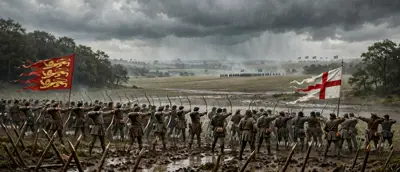
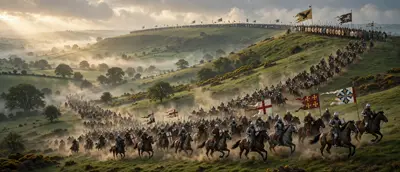
Picture a wheat field in northern Poland on a hot July morning in 1410. Two armies stand a few hundred yards apart, and between them lies the future of Eastern Europe. On one side, the Teutonic Order, the richest and most feared fighting force in Christendom, its white cloaks marked with black crosses. On the other, a Polish king and a Lithuanian duke who have bet everything on a single afternoon. By sunset, the Order's Grand Master is dead, its army is wrecked, and the most powerful force in the Baltic is finished. The place is called Grunwald in Polish, Žalgiris in Lithuanian, and Tannenberg in German. One field, three names, and a battle that still shapes how two nations see themselves today.
Why Were Poland and the Teutonic Order Even Fighting?
Start with the Order, because the Order is the reason this battle happened at all. The Teutonic Order began as a German crusading order in the Holy Land in the 1190s. In 1226, a Polish duke named Konrad of Masovia invited them to his border to fight the pagan Prussians. The knights stayed. Over the next century they conquered Prussia, built a state of their own, and raised Marienburg, the biggest castle in Europe, as their capital. They were monks and soldiers at the same time, and they were very good at both jobs.
Their excuse for war was religion. They were crusaders, and their mission was converting pagans by the sword. That worked fine while Lithuania was still pagan, the last pagan state in Europe. Then in 1385, everything changed. The Lithuanian Grand Duke Jogaila married the Polish queen Jadwiga, took the name Władysław II Jagiełło, and became king of Poland. Two years later, Lithuania converted to Christianity. The pagans were gone. But the Order kept fighting anyway, and everybody in Europe could see the excuse had worn thin.
The Battle of Tannenberg, known in Poland as Grunwald and in Lithuania as Žalgiris, was the decisive battle fought on July 15, 1410, between the Polish-Lithuanian alliance and the German Teutonic Order. The allies won a crushing victory, killed Grand Master Ulrich von Jungingen, and broke the Order's power in Eastern Europe for good.
The real fight was about land. Samogitia, a strip of territory in western Lithuania, sat between the Order's lands in Prussia and its lands in Livonia. The Order wanted it because it joined their two halves together. The Lithuanians wanted it because it was theirs. In 1409, the Samogitians rose up against the Order, and Vytautas, the Grand Duke of Lithuania, backed them openly. The Order declared war on Poland and Lithuania in August 1409. A truce held through the winter. And in the summer of 1410, both sides marched to settle it in the open field.
Jagiełło crossed the Vistula river on a pontoon bridge at Czerwińsk on July 3, 1410, joined up with Vytautas, and marched north into Prussia. The two armies circled each other for days. On July 14, they camped within sight of each other near the villages of Grunwald and Tannenberg. The next morning, they formed up for battle. And then, for hours, nothing happened. That waiting is part of the story.
Who Was Actually There? The Armies at Grunwald
So how big were these armies? Nobody knows for sure, and anyone who gives you one exact number is guessing. The main source is Jan Długosz, a Polish chronicler who wrote about the battle some 70 years later. He counted banners, the basic unit of a medieval army, and gave the allies about 91 banners against the Order's 51. Modern historians turn those counts into rough ranges: about 16,000 to 39,000 men on the allied side, and about 11,000 to 27,000 for the Order. The figures you will see most often are 39,000 against 27,000. Treat them as educated guesses, not a census.
The allied army was a patchwork, and that is what made it dangerous. The core was Polish heavy cavalry, armored knights on armored horses, the best shock troops in Eastern Europe. Next to them rode Vytautas's Lithuanians, light cavalry who fought with bows and speed instead of weight. There were Tatars under Jalal al-Din, the son of the deposed khan Tokhtamysh, Ruthenian troops from the east, and Czech and Moravian mercenaries. One of those Czechs was Jan Žižka, who would later become the most feared commander of the Hussite wars. Three banners of men from Smolensk held a place in the line, and they would matter more than anyone expected.
The Order's army looked tidier on paper. Its core was the brother-knights themselves, monks who had taken vows and trained for war since boyhood. There were only about 250 of them on the field, but each one fought alongside a retinue of squires, servants, and men-at-arms. Around that core stood crusading guests from Germany, France, and England, men who had come east for the prestige of fighting in a crusade, plus mercenaries and infantry. The Order also brought two bombards, early cannon. They would fire twice during the battle and hit almost nothing. Gunpowder had arrived in Europe. It had not arrived yet as a weapon that decided battles.
The commanders could not have been more different. Jagiełło, the Polish king, stayed back with the reserves, heard Mass twice on the morning of the battle, and prayed. Vytautas, his cousin, ran the fighting on the field. On the other side, Grand Master Ulrich von Jungingen led from the front, in full armor, at the head of his knights. He was confident. He had every reason to be. His Order had never lost a battle like this. That confidence is the thread that runs through everything that happened next.
And one more name worth knowing: Zawisza Czarny, Zawisza the Black, the most famous Polish knight of his generation. He fought at Grunwald, and he survived it. Ask a Polish schoolchild about this battle and Zawisza is one of the first names they will give you.
July 15, 1410: A Morning Spent Standing in the Sun
The armies formed up in the morning, and then they waited. Jagiełło heard Mass. Twice. The Order's knights stood in formation in the July sun, in full armor, watching a king pray. It was a deliberate insult, or a deliberate delay, and it worked. Men in steel do not enjoy standing still for hours in summer heat. The Order's patience ran out first.
Von Jungingen sent two heralds across the field carrying two bare swords. The message was a taunt: here are swords to help you fight, since you seem in no hurry. Jagiełło took them and answered, according to Długosz, that his army had plenty of swords already, but he accepted these too, in the name of Christ. The swords became the most famous symbol of the battle. Poles still talk about the two swords of Grunwald today, six centuries later, and paintings of the moment hang in Polish schools.
Two bare swords. A taunt. And a king who took them anyway.
Then, around nine in the morning, the fighting started. The Lithuanian light cavalry charged first, sweeping toward the Order's left wing. The Order's bombards fired. They missed, or nearly did. The two sides crashed together, and for about an hour the battle was a grinding, close-quarters fight in the dust. The Lithuanians were lightly armed against heavy cavalry, and they were taking the worst of it. Then they broke. And the whole battle turned on what that breaking meant.
Ever stood in armor under a July sun for three hours while your enemy prayed? The Order's men had. It is easy to forget, when you read about battles, that half the fighting happens before the first blow, in the waiting.
The Lithuanian Retreat: Trick or Disaster?
Here is the argument historians still have about Grunwald, six hundred years later. After about an hour of fighting, the Lithuanian wing turned and ran. The Order's knights chased them. Was it a feigned retreat, a steppe tactic the Lithuanians and Tatars knew well, designed to pull the enemy out of formation? Or was it a real collapse, and the Lithuanians simply could not take the punishment anymore? Długosz, writing for a Polish audience, called it a genuine flight. Modern historians are split. Some say planned. Some say panic. Nobody knows for sure, and the sources will not settle it.
What we do know is what happened in the gap the retreat left behind. The Teutonic knights who gave chase ran into the three banners from Smolensk, who stood their ground and refused to move. Those three banners, Russian troops from a city that had only recently joined the Lithuanian orbit, held the line while the Order's left wing chased a fleeing enemy across the field. It was one of the most stubborn stands of the day, and it saved the allied center from being rolled up.
And here is the thing about a feigned retreat, or a real one that works out the same way. A chasing army stops being an army. It becomes a crowd of men spread across a field, each riding after his own enemy. The Order's left wing was now scattered and tired, and the men who had stayed behind were fighting the Poles alone. Whether Vytautas planned it or luck handed it to him, the result was the same. The Order had spent its best punch on an enemy that was no longer there.
Meanwhile, the Polish center held. Jagiełło fed in reserves, his guard fought off a direct attack on the king himself, and the battle settled into a long, brutal grind. The Order was winning the fight in front of it and losing the battle around it. That is a strange sentence. It is also what happened.
And then the Lithuanians came back. Rallied by Vytautas, or simply having run far enough, they turned around and rode back into the fight, hitting the Order's flank. If the retreat was a trick, this was the payoff. If it was real, it was the greatest accident in medieval warfare. Either way, the Order was now fighting in two directions, and its day was running out.
The Last Charge: How Von Jungingen Died
By the afternoon, the battle had been going for hours, and von Jungingen made the decision that killed him. He took his last reserve, sixteen banners of his best knights, and charged the Polish right flank himself, at the head of his men. For a few minutes it worked. The Polish line bent. Men around the king were fighting for their lives. But the charge spent itself against fresh Polish reserves, and then the rallied Lithuanians hit the Order's flank. The sixteen banners were surrounded.
Von Jungingen died in the melee. The accounts disagree on the details, and you should be suspicious of any version that gives you a clean, cinematic death. What the sources agree on is that he was cut down in the fighting, surrounded by his men, and that most of the Order's senior commanders died with him: the Grand Marshal, Friedrich von Wallenrode, and the Grand Komtur, Kuno von Lichtenstein, among them. The Order lost its head in a single afternoon.
When the Grand Master's banner fell, the battle was over. The Order's great banner was captured and carried to Jagiełło. The camp was stormed. What was left of the Order's army broke and ran, and the allies pursued them until dark. The field was covered with the dead, and the chroniclers, as chroniclers do, counted them in the thousands and argued about the exact number for centuries afterward.
Długosz claimed 18,000 of the Order's men were killed and 14,000 taken prisoner. Modern historians put the dead at about 8,000, with thousands more captured. Allied losses were around 4,000 to 5,000 killed. The numbers are soft, but the shape is not in doubt. The Order's army was destroyed as a fighting force, and its leadership was wiped out in one day.
| Teutonic dead (Dlugosz) | 18,000 claimed; modern estimate about 8,000 |
|---|---|
| Teutonic prisoners (Dlugosz) | 14,000 claimed |
| Allied dead | About 4,000 to 5,000 |
| Senior commanders lost | Grand Master von Jungingen, Grand Marshal von Wallenrode, Grand Komtur von Lichtenstein |
| Banners on the field | About 91 allied banners vs about 51 Teutonic banners (Dlugosz) |
| The two swords | Sent by von Jungingen as a taunt; kept by Jagiełło, a Polish national symbol ever since |
The Victory That Almost Wasn't: Marienburg and the Peace of Thorn
And here is the honest downside, the part the victory songs usually skip. The allies won the battle, then nearly wasted the war. They marched on Marienburg, the Order's capital, the greatest fortress in Europe. And they could not take it. The siege lasted from July 26 to September 19, 1410, and it failed. Heinrich von Plauen, the Order's commander at the fortress, organized the defense, the walls held, and the allied army, exhausted, short of supplies, and hit by dysentery, went home. The Lithuanians left first. The Poles followed. The greatest victory in Polish history ended with the enemy's capital still standing.
The peace that followed was modest, almost embarrassingly so for a victory this complete. The First Peace of Thorn, signed on February 1, 1411, gave Poland back the Dobrzyń Land, gave Samogitia to Lithuania for Vytautas's lifetime, and made the Order pay a large indemnity. That was about it. The Order kept its state, its lands, and its castles. Jagiełło, for reasons historians still argue about, did not press his advantage. Maybe his army was spent. Maybe he wanted a quick peace. Either way, the Order survived Grunwald.
But surviving is not the same as recovering. The Order never got its power back. The indemnity emptied its treasury, and it had to tax its own towns to pay, which turned its subjects against it. The towns and the Prussian nobility started organizing against the Order, and within a few decades they were asking the Polish king for protection. There were more wars, the Hunger War of 1414, the settlement at Melno in 1422, and finally the Thirteen Years' War, which ended with the Second Peace of Thorn in 1466. That one finished the job: the Order lost western Prussia and became a vassal of the Polish crown. In 1525, what was left of the Order's state became the secular Duchy of Prussia. Grunwald did not kill the Order in a day. It broke its spine, and the rest took fifty years.
If you want the short version, it is this: the battle was a masterpiece, and the follow-through was a mess. Winning the field is not the same as winning the war, and Grunwald is the clearest example of that in medieval history. The allies had the enemy beaten and let the peace slip through their fingers. The Order's luck was that its enemies were too tired to finish the job. Its tragedy was that the wound never healed.
Why Grunwald Still Matters (and Why 1914 Stole Its Name)
So why does a battle from 1410 still matter? Start with Poland and Lithuania. Grunwald is their founding story, the moment two nations stood together and beat the most feared army in Europe. Polish schoolchildren learn it by heart. The two swords are a national symbol. Jan Matejko painted the battle in 1878, a huge canvas that now hangs in the National Museum in Warsaw, and it is one of the most famous paintings in Polish history. Every July, thousands of reenactors gather on the fields near Grunwald to fight the battle again, and tens of thousands of people come to watch. The novel "The Knights of the Cross," written by Henryk Sienkiewicz in 1900, put the battle into the hands of ordinary readers, and it has stayed there ever since.
And then there is the name. In August 1914, at the start of the First World War, the German Eighth Army under Paul von Hindenburg destroyed a Russian army near the same ground. Hindenburg named the victory Tannenberg on purpose, to avenge 1410. It was propaganda, and it worked. The Germans built a huge memorial on the site, buried Hindenburg there twenty years later, and the name Tannenberg became German again. Our guide to the Battle of Tannenberg 1914 tells that story, but it only exists because of what happened on the same fields five centuries earlier.
Honestly, the 1914 naming tells you how much 1410 still stung. Five hundred years after the battle, a German general still felt the need to settle the score. That is what a real defeat does. It echoes. The Poles call the battle Grunwald, the Lithuanians call it Žalgiris, and the Germans call it Tannenberg. Three names for one field, and each one is a claim about who the field belongs to.
Five years later, at Agincourt, Henry V would win his own famous victory against the odds, though with longbows instead of heavy cavalry. Different war, different weapons, same lesson: the side that picks its ground and keeps its nerve usually walks away with the day.
If you visit the battlefield today, you will find a museum, a monument, and a quiet stretch of fields in northern Poland. It does not look like the center of Europe. But for one afternoon in 1410, it was. And the next time someone tells you a single battle cannot change history, send them to Grunwald.
A Note on the Numbers: What the Sources Actually Say
Honest history comes with asterisks, and Grunwald has its share. Almost everything we know about the battle comes from Jan Długosz, a Polish chronicler who wrote his account some seventy years after the event. He was writing for a Polish audience, he never saw the battle, and his numbers, 18,000 of the Order's men killed and 14,000 taken prisoner, are almost certainly too high. Modern historians work with about 8,000 dead on the Order's side and 4,000 to 5,000 on the allied side, with thousands more captured. The army sizes are ranges for the same reason: about 16,000 to 39,000 on the allied side, about 11,000 to 27,000 for the Order.
What is not in doubt: the date, July 15, 1410, the place, the commanders, the two swords, the death of von Jungingen, the outcome, and the Peace of Thorn on February 1, 1411. The rest is ranges and arguments, and that is normal for a medieval battle. When sources disagree, this article says so instead of picking the most dramatic number.
3 Lessons from Grunwald
Grunwald is a battle, but it is also a case study in winning a war. Three lessons worth stealing:
1. Win the war before the battle. The alliance that won Grunwald was built years earlier: the marriage at Krewo in 1385, the conversion of Lithuania, the treaties with the Tatars and the Czechs, the money to hire mercenaries. Jagiełło and Vytautas did not win on July 15. They won in the years before, by making sure they would not fight alone. Battles reward the side that did the boring diplomatic work first.
2. A plan only works if your center holds. The Lithuanian retreat, planned or not, only worked because the Smolensk banners and the Polish center stayed put. If they had run too, the Order would have rolled the whole army up. Every bold maneuver needs someone stubborn holding the middle. Find those people before you need them.
3. Finish the job, or the job finishes you later. The allies won the greatest battle of the age and then failed at Marienburg and settled for a modest peace. The Order survived, and it took fifty more years to finish what Grunwald started. A victory you do not follow up is a victory you rent, not one you own.
Want to go deeper? Start with Długosz, then walk the field in July, when the reenactors bring it back to life. The ground is still there. The swords are still in the story. And the lesson is still the same: pick your allies, hold your center, and finish the job.
Sources
- Wikipedia, Battle of Grunwald
- Britannica, Teutonic Order
- Muzeum Grunwald, grunwald.pl
- Jan Długosz, Annals of Jan Długosz
- William Urban, Tannenberg and After: Lithuania, Poland and the Teutonic Order (2003)